
 Israel
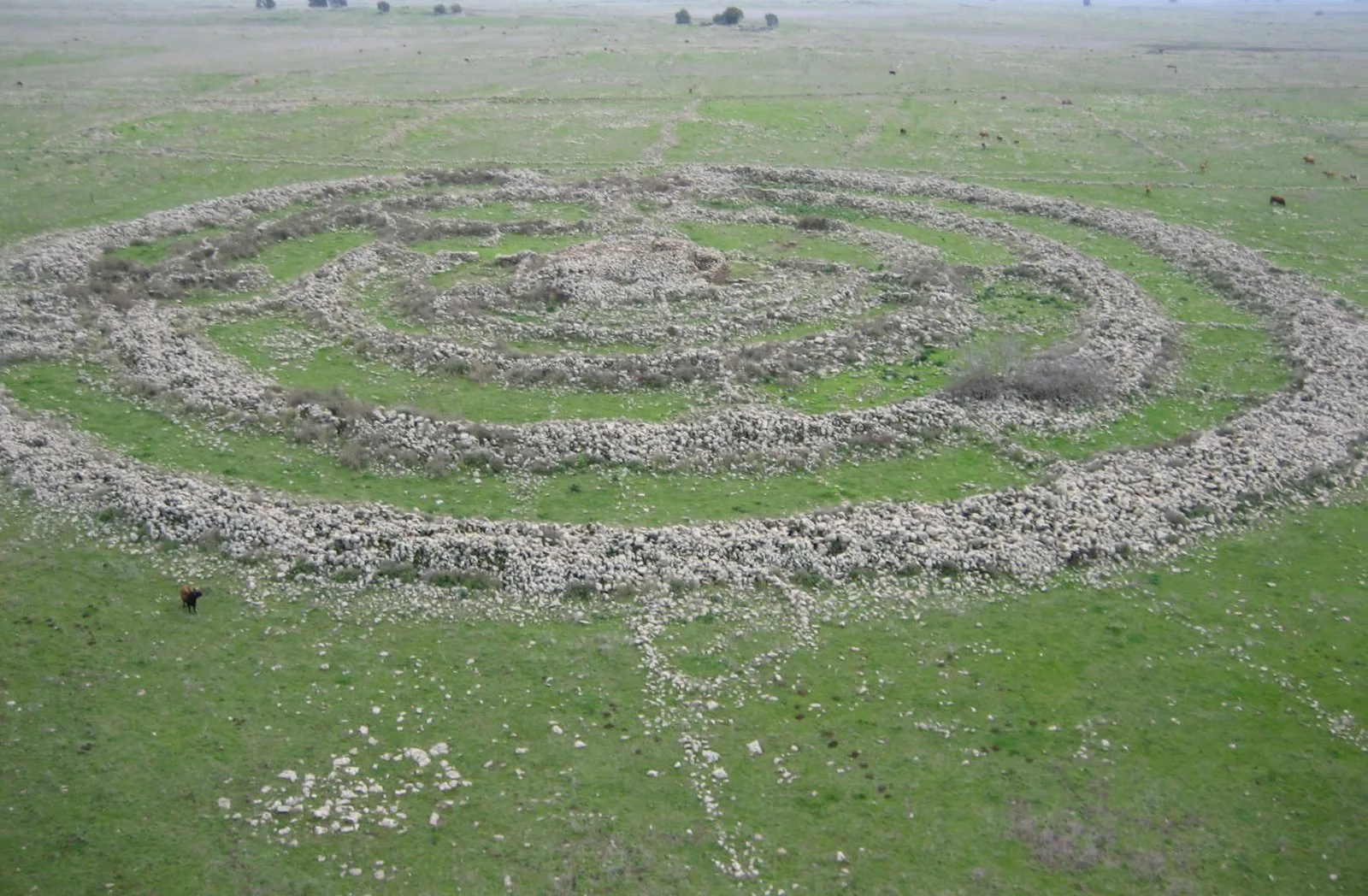
Rujm el-Hiri or Gilgal Refaim, and also known as the Wheel of Giants, is an ancient stone, or megalithic, structure consisting of concentric circles of stone with a tumulus, a mound of earth and stone, at its center [1]. It is located in the Golan Heights some 16 kilometres east of the coast of the Sea of Galilee, in the middle of a large plateau covered with hundreds of dolmens, single chamber tombs of stone [1]. Made up of more than 42,000 basalt rocks arranged in concentric circles, Rujm al-Hiri has a mound 15 feet tall at its center [1]. The establishment of the site, and other nearby ancient settlements, is dated by archaeologists to the Early Bronze Age II period (3000–2700 BCE) [1]. The remains consist of a large circle of basalt rocks containing four smaller concentric circles, each getting progressively thinner; some are complete, others incomplete [1]. The site was cataloged during an archaeological survey carried out in 1967–1968 by Shmarya Guttman and Claire Epstein [1].
Text: Wikipedia – 'Rujm el-Hiri' (revision of 2026-09-02), CC BY-SA 4.0 · sentences selected and shortened by an AI system · source →Rujum Al-Hiri
Also known as: Gilgal Refaim, Gilgal Refajim, Rogem Hiri, Rudžm el-Hiri, Rujm al-Hiri, Rujm al Hirrī, Rujm el-Hiri, Колелото на душите, Колесо духів, Колесо духов, גלגל רפאים, رجم الهري
| Type | Megalithic structures |
|---|---|
| Period | 3000 - 1500 BC |
| Country | Israel |
| Coordinates | 32.9087° N, 35.8007° E |