
 Israel
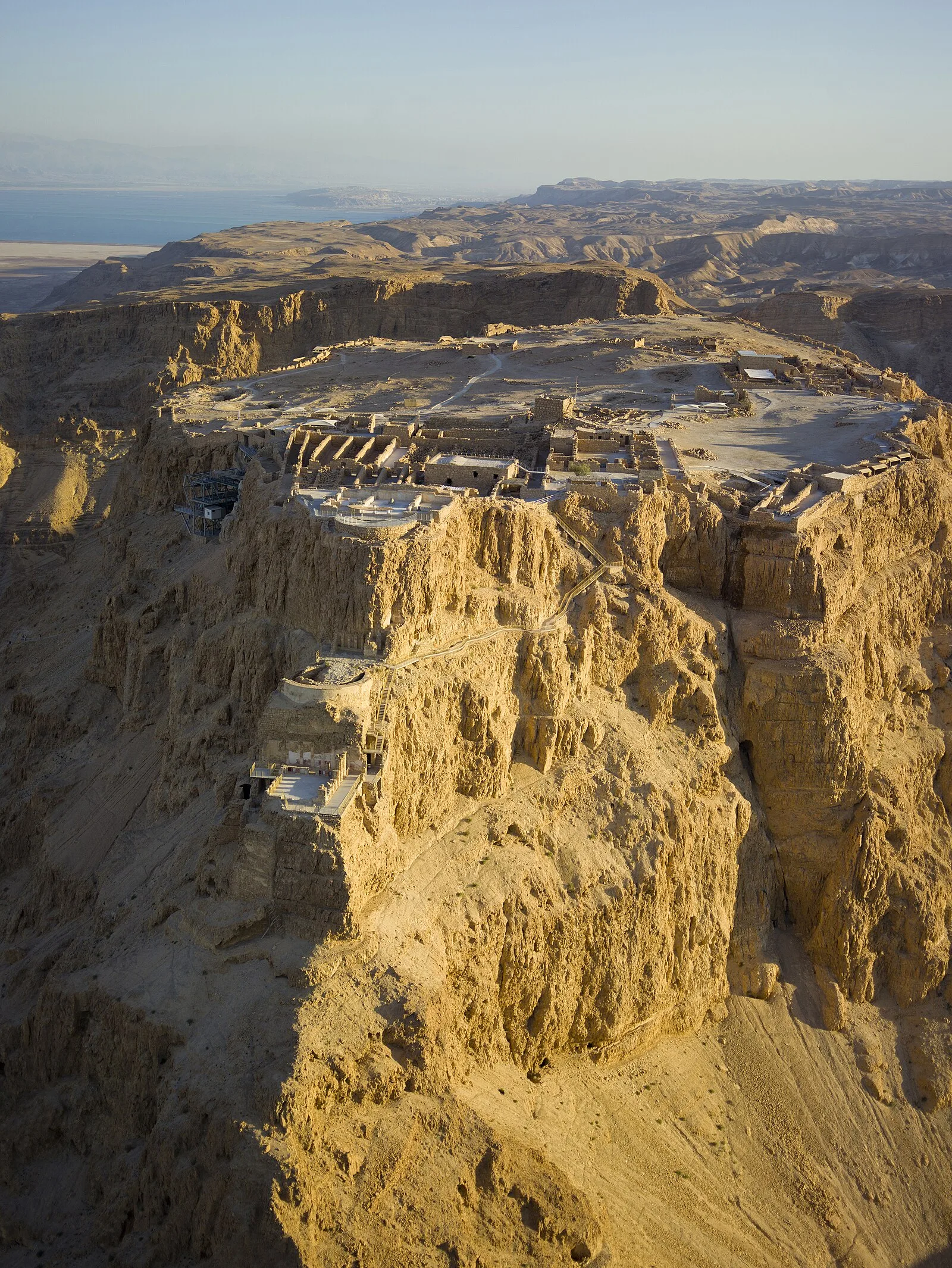
Masada is a mountain-top fortress complex in the Judaean Desert, overlooking the western shore of the Dead Sea in southeastern Israel [1]. The fort, built in the first century BC, was constructed atop a natural plateau rising over 400 m above the surrounding terrain, 20 km east of modern Arad [1]. The most significant remains at the site date to the reign of Herod the Great, King of Judaea under Roman administration c. 37–4 BC, who transformed Masada into a fortified desert refuge early in his rule [1]. He enclosed the summit with a casemate wall and towers, and constructed storerooms, an advanced water system, and bathhouses, along with two elaborate palaces: one on the western side and another built across three terraces on the northern cliff [1]. Masada is most renowned for its role during the First Jewish–Roman War, when it became the final holdout of Jewish rebels following the destruction of Jerusalem [1]. The Romans laid siege by building a circumvallation wall and a massive ramp [1].
Text: Wikipedia – 'Masada' (revision of 2026-08-29), CC BY-SA 4.0 · sentences selected and shortened by an AI system · source →Masada National Park
Also known as: 마사다, Assedio di Masada, Belagerung von Masada, Fortaleza de Massada, Forteresse de Massada, Fortezza di Masada, Masada, Masados tvirtovė, Massada, Massada-Nationalpark, Masszáda, Matsada
| Type | Fortress/citadel |
|---|---|
| Period | 500 BC - 1 AD |
| Country | Israel |
| Coordinates | 31.3130° N, 35.3549° E |