
 Israel
The Tombs of the Kings are a rock-cut funerary complex in East Jerusalem believed to be the burial site of Queen Helene of Adiabene (died c. 50–56 CE) [1]. More recent research by noted French scholar and Dominican friar Jean-Baptiste Humbert has concluded that the tomb was likely designed for Herod Agrippa I, the grandson of Herod the Great [1]. From street level a hewn staircase, measuring 9 metres in width and having a length of 30 metres, descends into a carved courtyard [1]. The main courtyard sinks down to a depth of 8.5 metres within the bedrock and has a total measurement of approximately 27 metres x 26 metres [1]. The tomb is mentioned by the Roman-Jewish historian Josephus in the first century CE [1]. In 1863, the French archaeologist Félicien de Saulcy was given permission to excavate the tomb [1]. De Saulcy found sarcophagi, one of which was bearing the Hebrew inscription "Queen Tzaddah" [1].
Text: Wikipedia – 'Tombs of the Kings (Jerusalem)' (revision of 2026-07-07), CC BY-SA 4.0 · sentences selected and shortened by an AI system · source →Tombs of the Kings
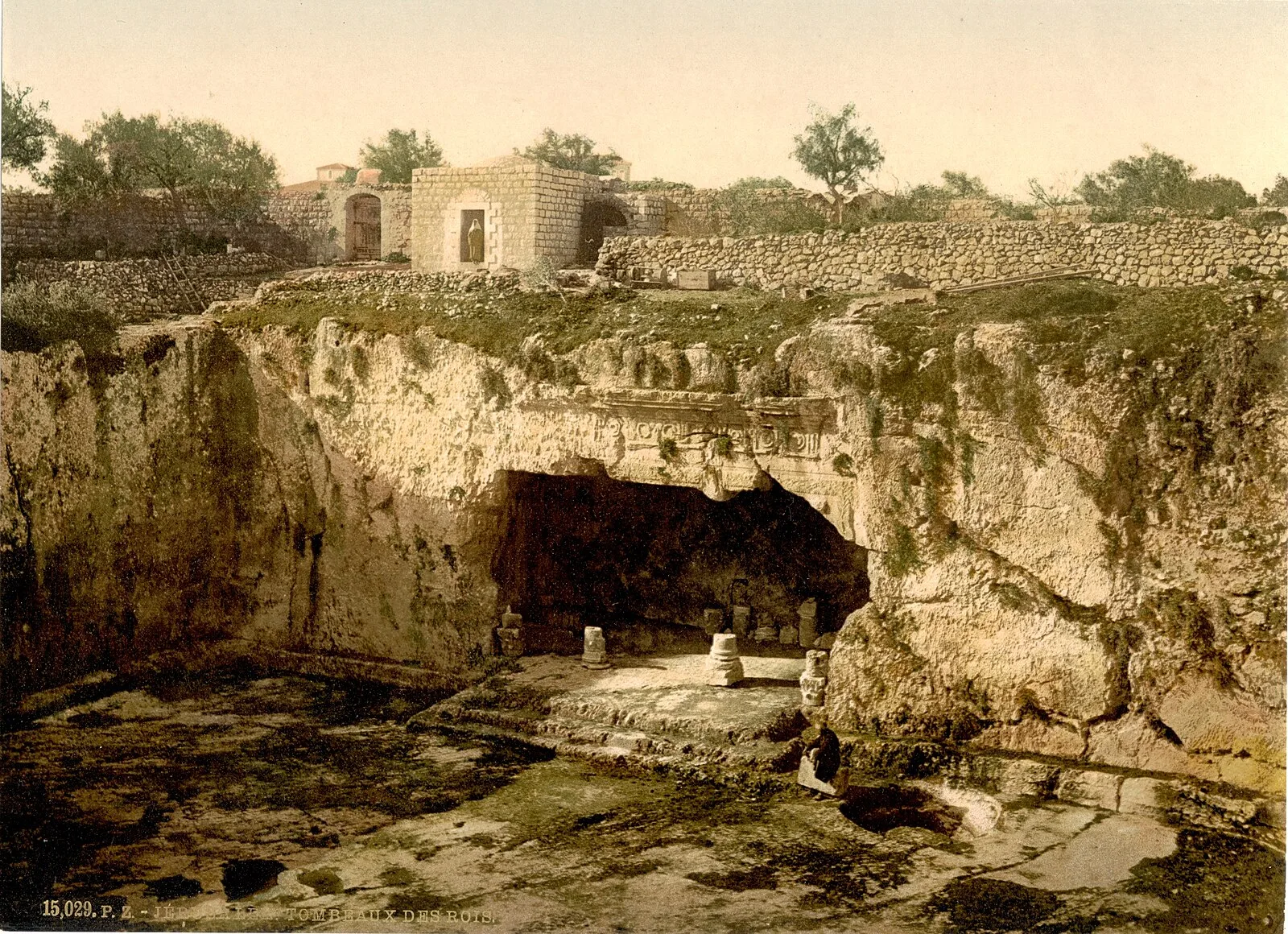
Also known as: Grab der Helene von Adiabene, Grobowiec Królów, Hrobka královny Heleny z Adiabene, Hrobka králů, Qobour el-Molouk, Tombeau des Monobaze, Tombeau des Rois, Tombeau d'Hélène d'Adiabène, Tombs of the Kings (Jerusalem), Tumbas de los Reyes, Tumbas de los Reyes (Jerusalén), מערת המלכים
| Type | Necropolis/tombs complex |
|---|---|
| Period | 1 - 500 AD |
| Country | Israel |
| Coordinates | 31.7885° N, 35.2292° E |