
 Iraq
IraqThe Ishtar Gate was the eighth gate to the inner city wall of Babylon (in the area of present-day Hillah, Babylon Governorate, Iraq) [1]. The design of the Ishtar Gate also includes linear borders and patterns of rosettes [1]. The bricks of the Ishtar gate were made from finely textured clay pressed into wooden forms [1]. Once per year, the Ishtar Gate and connecting Processional Way were used for a New Year's procession, which was part of a religious festival celebrating the beginning of the agricultural year [1]. The inscription of the Ishtar Gate is written in Akkadian cuneiform in white and blue glazed bricks and was a dedication by Nebuchadnezzar to explain the gate's purpose [1]. On the wall of the Ishtar Gate, the inscription is 15 meters tall by 10 meters wide and includes 60 lines of writing [1]. A reconstruction of the Ishtar Gate and Processional Way was built at the Pergamon Museum in Berlin out of material excavated by Robert Koldewey [1].
Text: Wikipedia – 'Ishtar Gate' (revision of 2026-09-15), CC BY-SA 4.0 · sentences selected and shortened by an AI system · source →Ishtar Gate
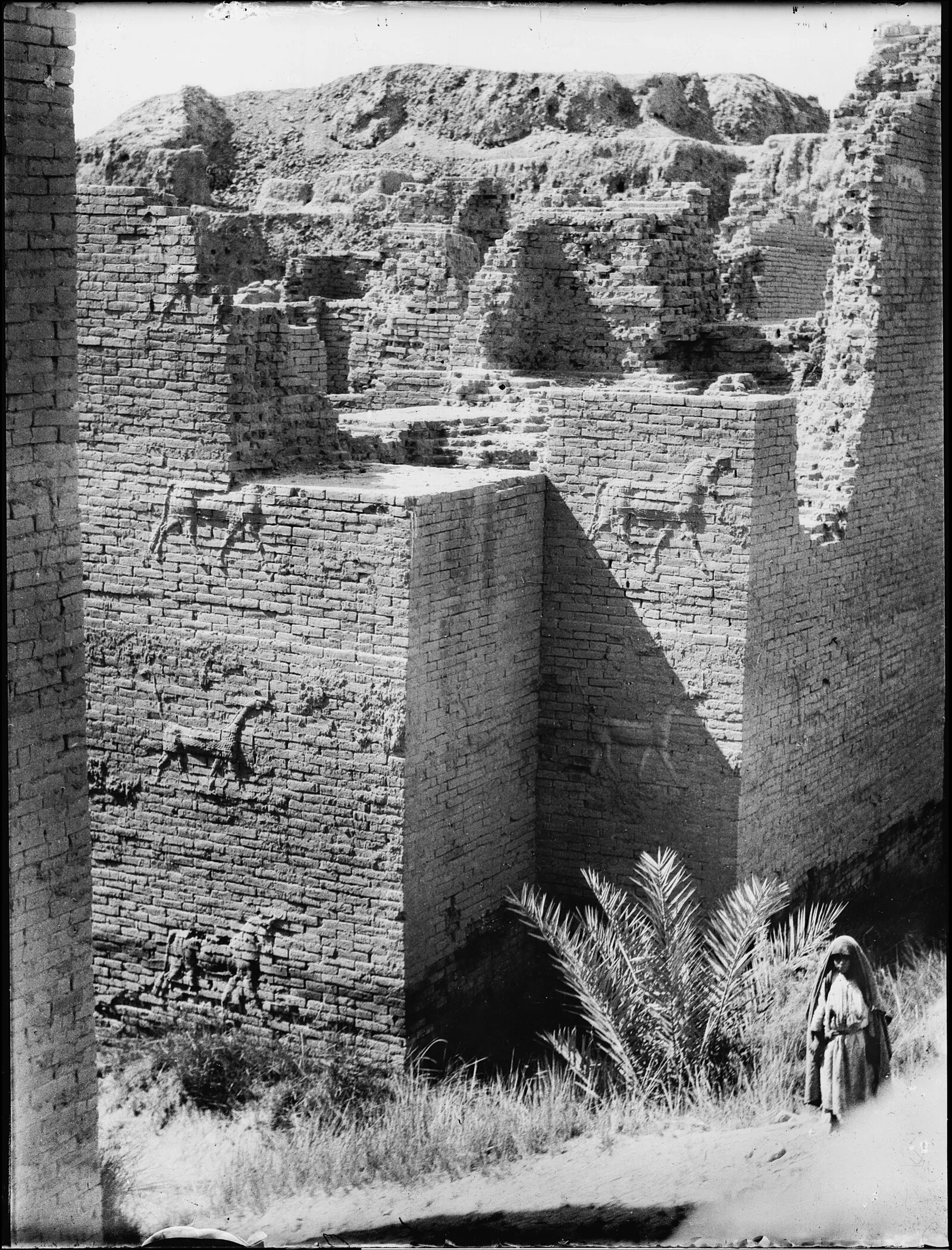
Also known as: 이슈타르의 문, Brama Isztar, Cổng Ishtar, Dor Ishtar, Gerbang Ishtar, Ischtartor, Ischtar-Tor, Ishtar Atea, Ishtar darvozasi (Bobil), Ishtar-eko atea, Ishtarin portti, Ishtarko atea
| Type | Gate/archway/bridge |
|---|---|
| Period | 1500 - 500 BC |
| Country | Iraq |
| Coordinates | 32.5435° N, 44.4222° E |