
 Greece
The Temple of Roma and Augustus was a monopteral circular Ionic temple built on the Acropolis of Athens c. 19 BCE, likely coincident with Augustus' second visit to Athens [1]. The structure was axially aligned with the eastern entrance of the Parthenon, placed 23 m eastward [1]. The temple, which asserted the divinity of Rome and the Imperial cult in the context of the religious centre of the Acropolis, was a propaganda monument erected at a time of tension between Rome and Athens [1]. The Pentelic marble temple was at its greatest diameter 8.6 m, and likely measured 7.36 m in height [1]. The building had one step and a stylobate on which its nine columns stood [1]. It had no interior wall, making it a monopteros, and might have been the frame or setting for a statue or other cult object [1]. In style it recalls the columns of the Erechtheion with elaborately carved floral motifs at the top of the shaft, making it an early example of the Roman classicizing Neo-Attic style [1]. The building had a sloping conical marble roof [1].
Text: Wikipedia – 'Temple of Roma and Augustus' (revision of 2026-01-14), CC BY-SA 4.0 · sentences selected and shortened by an AI system · source →Temple of Roma and Augustus
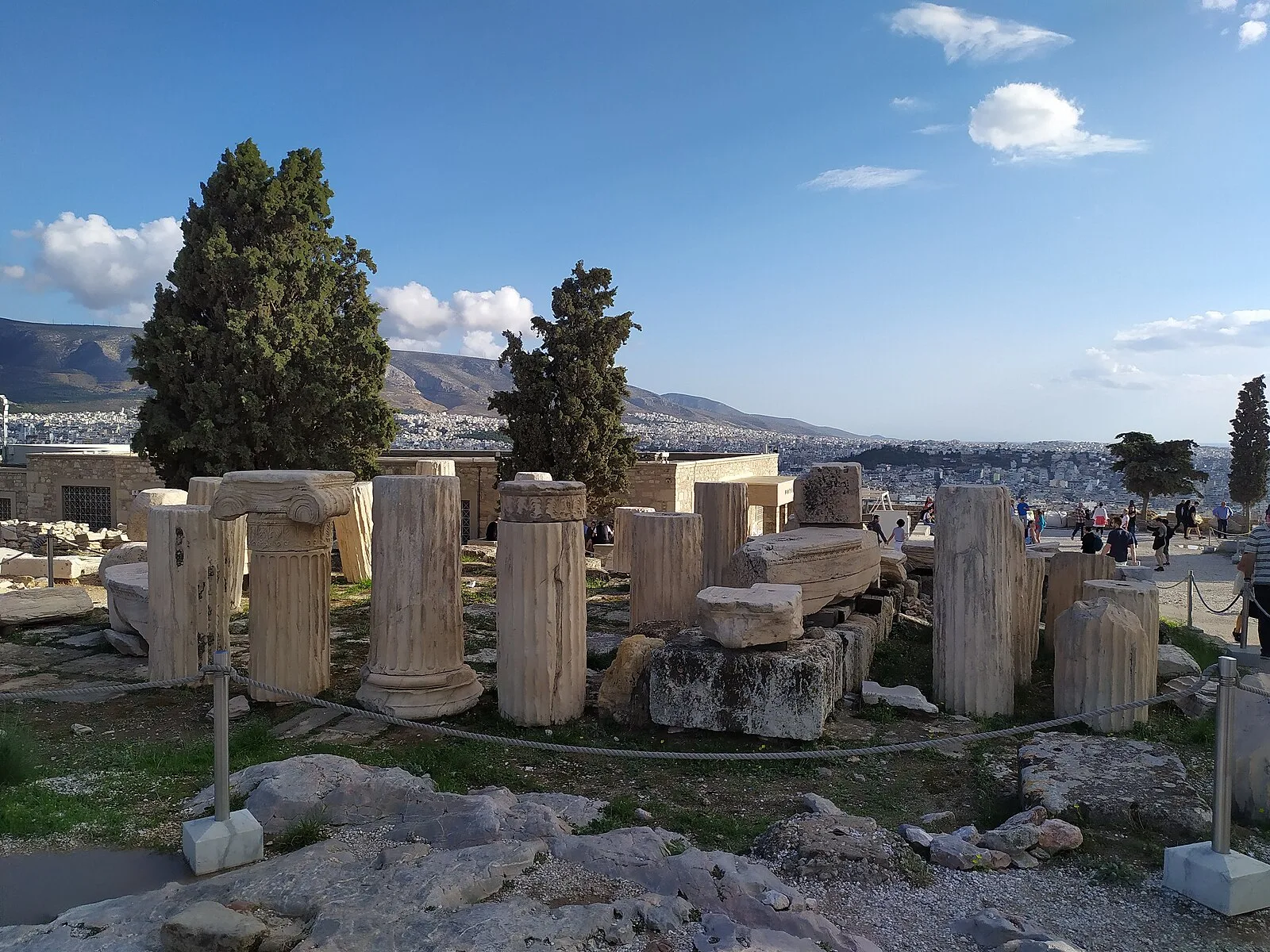
Also known as: Rooman ja Augustuksen temppeli, Tempel der Roma und des Augustus (Athen), tempelj Avgusta in boginje Rome, Tempel van Roma en Augustus, Tempio di Roma e di Augusto, temple de Roma i August, temple de Rome et d'Auguste, Temple of Rome and Augustus, Templo de Augusto y Roma, Templo de Roma e Augusto, Templo de Roma y Augusto, Templo de Roma y Augusto (Atenas)
| Type | Temple complex |
|---|---|
| Period | 500 BC - 1 AD |
| Country | Greece |
| Coordinates | 37.9716° N, 23.7267° E |