
 France
The Pair-non-Pair Cave is located near the village of Prignac-et-Marcamps [1]. Only discovered in 1881 it is known for remarkable prehistoric parietal engravings - petroglyphic representations of wild animals, "which rank among the most ancient examples of art made by prehistoric" humans, dating back to between 30,000 and 25,000 BP [1]. The third decorated cave ever to be discovered after Altamira in Spain and the Chabot cave in Ardèche it was the first cave ever to be classified and listed as a historical monument in France on December, 20th 1901 [1]. Excavations under the leadership of archaeologist François Daleau began immediately in March 1881 lasting until 1913 [1]. Apart from the petroglyphs, wall paintings, 15000 stone tool fragments and around 6000 animal bones of 60 species were unearthed and recorded [1]. Human occupation took place over a period spanning 60,000 years from the Mousterian, the Chatelperronian, the Aurignacian and into the Gravettian cultures [1]. Most animals carved on the walls of the cave are represented in pairs [1].
Text: Wikipedia – 'Pair-non-Pair' (revision of 2026-07-19), CC BY-SA 4.0 · sentences selected and shortened by an AI system · source →Pair-non-Pair Cave
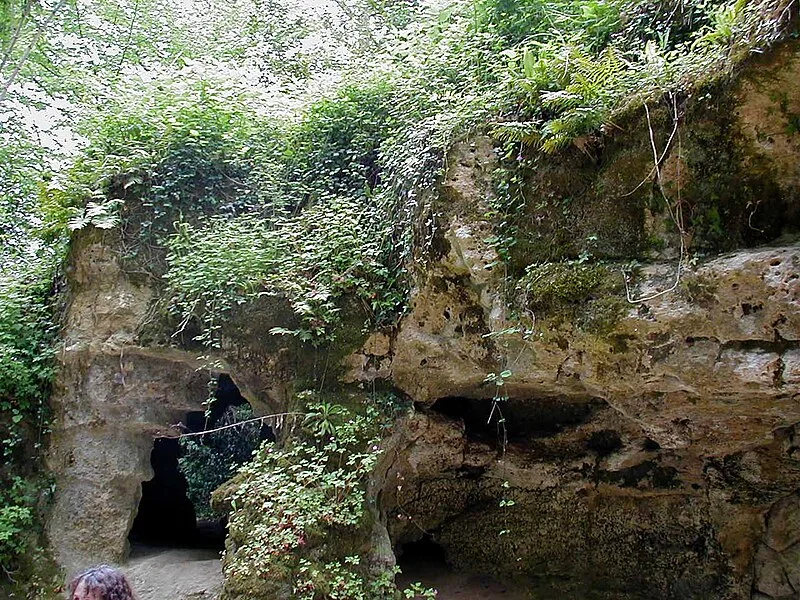
Also known as: Bauma de Par non Par, grotte de Pair-non-Pair, Grotte von Pair-non-Pair, Grot van Pair-non-Pair, Höhle von Pair-non-Pair, Pair-non-Pair, Пер-нон-Пер, Пещера Пер-нон-Пер
| Type | Cave Structures |
|---|---|
| Period | < 4500 BC |
| Country | France |
| Coordinates | 45.0390° N, 0.5018° W |