
 Egypt
EgyptThe Giza pyramid complex (also called the Giza necropolis) in Egypt is home to the Great Pyramid, the pyramid of Khafre, and the pyramid of Menkaure, along with their associated pyramid complexes and the Great Sphinx [1]. All were built during the Fourth Dynasty of the Old Kingdom of ancient Egypt, between c. 2600 – c. 2500 BC [1]. The site also includes several temples, cemeteries, and the remains of a workers' village [1]. The site is at the edge of the Western Desert, approximately 9 km west of the Nile River in the city of Giza, and about 13 km southwest of the city centre of Cairo [1]. It forms the northernmost part of the 16,000 ha Pyramid Fields of the Memphis and its Necropolis UNESCO World Heritage Site, inscribed in 1979 [1]. Most of the limestone used to build the pyramids originates from the underlying Mokattam Formation [1]. The Great Sphinx lies on the east side of the complex [1]. Consensus among Egyptologists is that the head of the Great Sphinx is that of Khafre [1].
Text: Wikipedia – 'Giza pyramid complex' (revision of 2026-08-22), CC BY-SA 4.0 · sentences selected and shortened by an AI system · source →Giza Necropolis
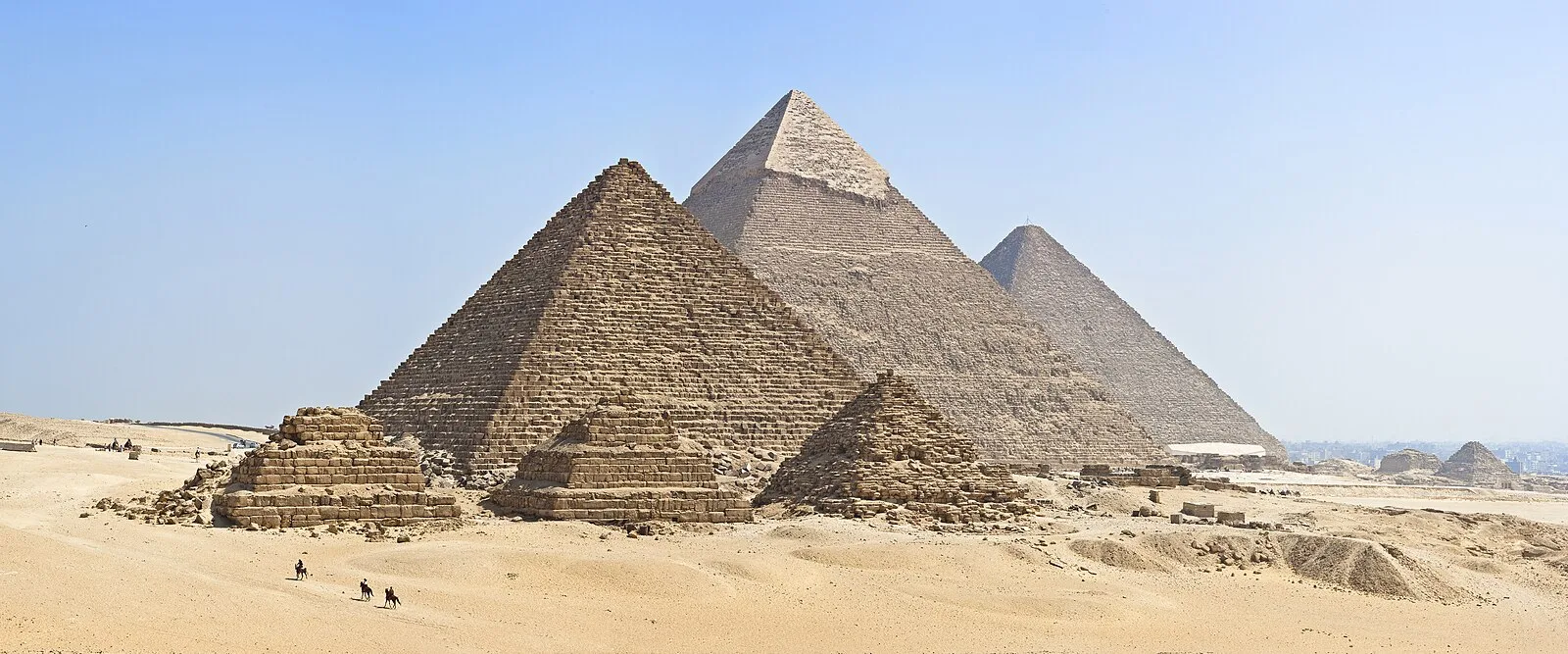
Also known as: 기자의 피라미드, Ansem ëd la piràmid ëd Giza, Cizä piramidaları, Cizə ehramları, Giza, gízai piramisok, Gizako nekropolia, Gizako piramideak, Gizan pyramidit, Giza piramidalari, Gizaplatån, Giza püramiidid
| Type | Pyramid complex |
|---|---|
| Period | 3000 - 1500 BC |
| Country | Egypt |
| Coordinates | 29.9781° N, 31.1326° E |