
 Croatia
The Golden Gate, or "the Northern Gate", is one of the four principal Roman gates into the stari grad of Split [1]. Built as the main gate of Diocletian's Palace, it was elaborately decorated to mark its status [1]. Over the course of the Middle Ages, the gate was sealed off and lost its columns and statuary [1]. The gate stood at a terminal point of the road which led north towards Salona, Diocletian's birthplace and the capital of the Roman province of Dalmatia [1]. It was probably used by Diocletian to enter the palace after his abdication from the imperial throne on 1 May 305 [1]. The Romans of late antiquity called the structure Porta Septemtrionalis [1]. The Porta Septemtrionalis was the "main landward gate" of Diocletian's palace, located in the middle of the northern wall [1]. Its exterior opening measures 4.17 by 4.36 meters; above the lintel is a 3.02-meter-high arch composed of 19 stone blocks [1].
Text: Wikipedia – 'Golden Gate (Diocletian's Palace)' (revision of 2026-07-21), CC BY-SA 4.0 · sentences selected and shortened by an AI system · source →Golden Gate - Diocletian's Palace
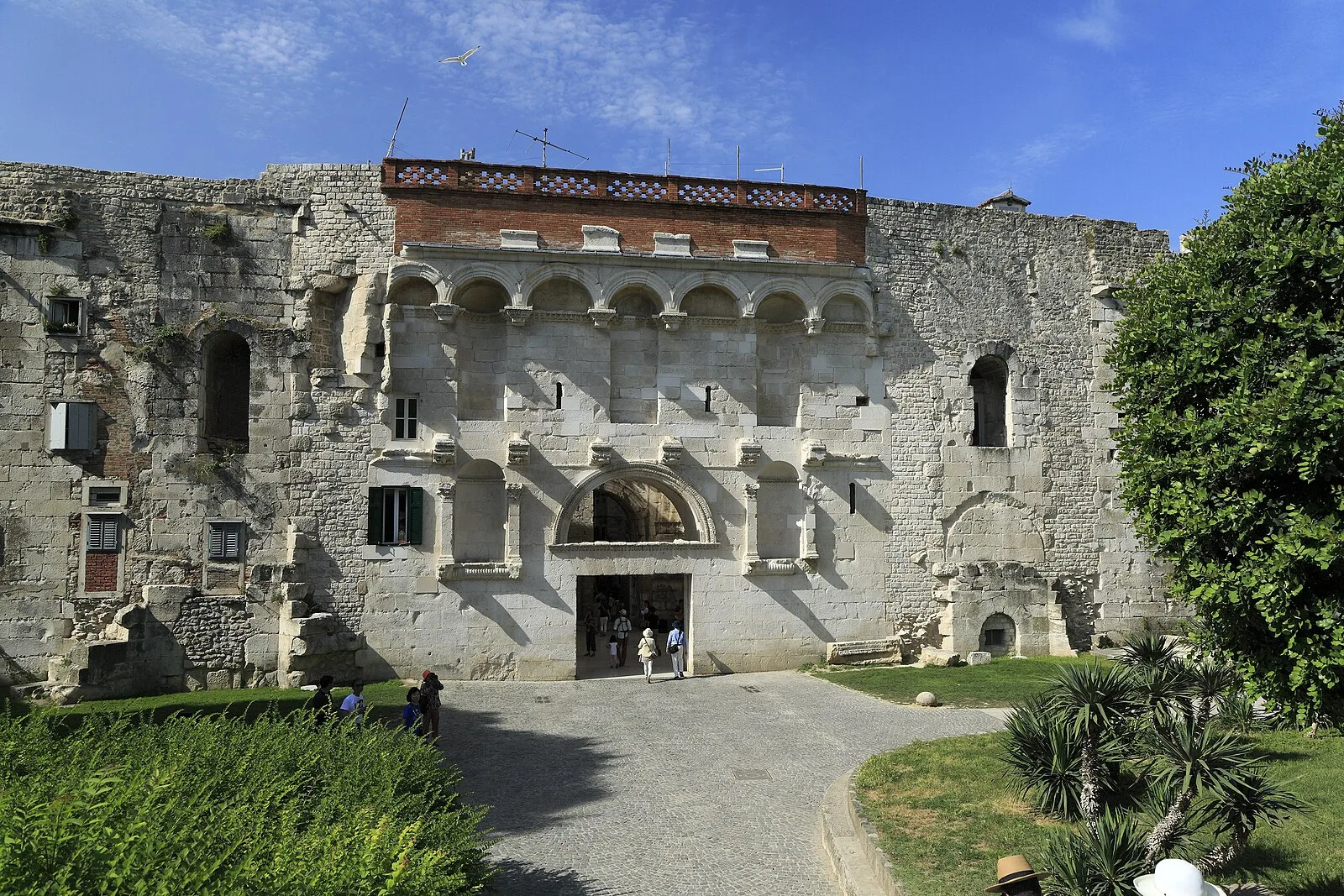
Also known as: Diocletian's Palace Golden Gate, Goldenes Tor, Golden Gate, Golden Gate (Diocletian's Palace), Gyllene porten, Gyllene porten, Split, Porta Aurea, Porta Aurea (Spalato), Porte Dorée, Puerta dorada, Zlatá brána, Zlatá brána (Split)
| Type | Gate/archway/bridge |
|---|---|
| Period | 1 - 500 AD |
| Country | Croatia |
| Coordinates | 43.5093° N, 16.4405° E |