
 Croatia
The Aqueduct of Diocletian is an ancient Roman aqueduct near Split, Croatia (Latin: Spalatum) constructed during the Roman Empire to supply water to the palace of the emperor Diocletian, who was Augustus 284 to 305 AD, retired to Spalatum, and died there in 311 [1]. The Aqueduct of Diocletian was constructed between the end of 3rd and beginning of the 4th century AD, at the same time as the palace [1]. The aqueduct took water from the river Jadro, 9 kilometres northeast of Diocletian's Palace, today Split's city centre, and brought water to the Palace over a height difference of 13 m [1]. The first reconstruction of the aqueduct took place during the reign of the Austro-Hungarian Empire (1877–1880) [1]. The Diocletianic aqueduct was abandoned in 1932, when the modern water station was built in Kopilica, a peripheral area of Split [1].
Text: Wikipedia – 'Aqueduct of Diocletian' (revision of 2025-10-04), CC BY-SA 4.0 · sentences selected and shortened by an AI system · source →Aqueduct of Diocletian
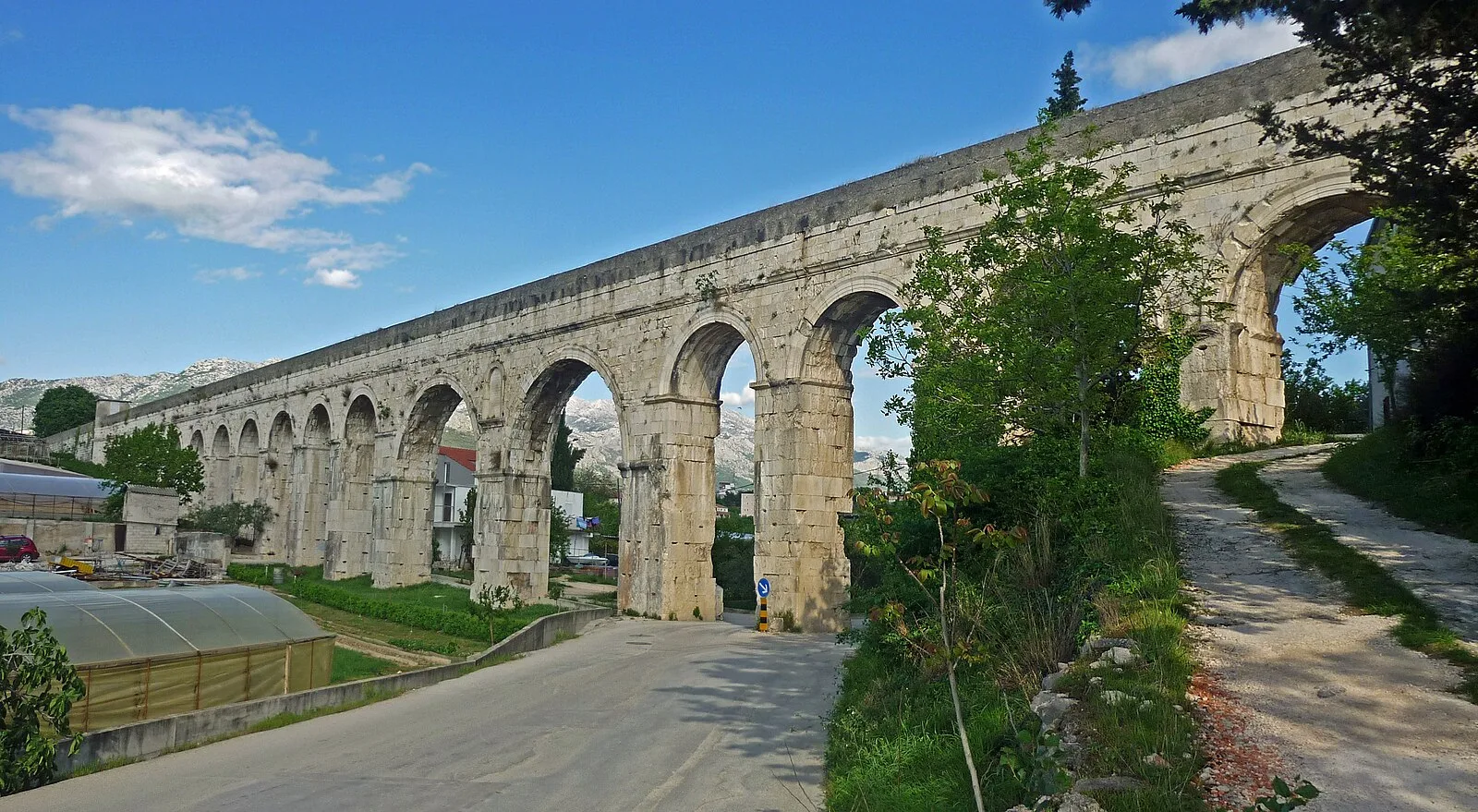
Also known as: 디오클레티아누스 수도교, Acquedotto di Diocleziano, Acueducto de Diocleciano, aqueduc de Dioclétien, Aqüeducte de Dioclecià, Diocletianus akvedukt, Diocletianus Aqueduct, Dioklecijanov akvadukt, Dioklecijanov akvedukt, Dioklecijanov vodovod, Diokletian-Aquädukt, Акведук Диоклетиана
| Type | Reservoir/aqueduct/canal |
|---|---|
| Period | 1 - 500 AD |
| Country | Croatia |
| Coordinates | 43.5243° N, 16.4895° E |