
 Bulgaria
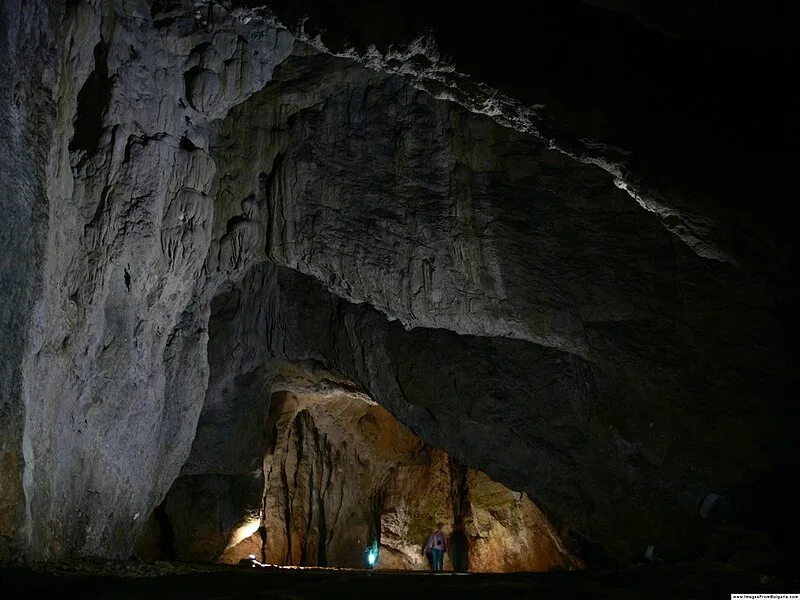
The Bacho Kiro Cave is situated 5 km west of the town Dryanovo, Bulgaria, only 300 m away from the Dryanovo Monastery [1]. It is embedded in the canyons of the Andaka and Dryanovo River [1]. The cave is a four-storey labyrinth of galleries and corridors with a total length of 3,600 m [1]. The site has yielded the oldest human remains ever to be found in Bulgaria [1]. At one of the earliest known Aurignacian burials (layer 11), two pierced animal teeth were found and ordered into the distinct Bachokiran artifact assemblage [1]. Radiocarbon dated to over 43,000 years ago, they currently represent the oldest known ornaments in Europe [1]. With an approximate age of 46,000 years, human fossils consist of a pair of fragmented mandibles including at least one molar [1]. Whether these early humans were in fact Homo sapiens or Neanderthals was disputed until morphological analysis of a tooth and mitochondrial DNA of bone fragments established that remains were those of Homo sapiens [1].
Text: Wikipedia – 'Bacho Kiro Cave' (revision of 2026-08-13), CC BY-SA 4.0 · sentences selected and shortened by an AI system · source →Bacho Kiro Cave
Also known as: Bacho Kiro, Bačo Kiro ala, Baço Kiro mağarası, Bacso Kiro-barlang, Baczo Kiro, Baczo Kiro (jaskinia), Batjo Kiro, Batscho-Kiro-Höhle, Batsjo Kiro grot, Batsjo Kirogrot, Batšo Kiron luola, cova de Batxo Kiro
| Type | Cave Structures |
|---|---|
| Period | < 4500 BC |
| Country | Bulgaria |
| Coordinates | 42.9468° N, 25.4303° E |