
 Bulgaria
The Amphitheatre of Serdica was an amphitheatre in the Ancient Roman city of Ulpia Serdica, now Sofia, the capital of Bulgaria [1]. Discovered in 2004 and the subject of excavations in 2005 and 2006, the ruins of the amphitheatre lie on two adjacent sites in the centre of modern Sofia [1]. The amphitheatre was built in the 3rd–4th century AD on top of a 2nd–3rd century theatre, which had been ravaged by the Goths [1]. However, the amphitheatre remained in use for less than a century and was abandoned by the 5th century [1]. As evidenced by coin and ceramic findings, including a rare bronze medallion of Antinous, the amphitheatre was constructed on top of the theatre ruins in two stages during the late 3rd and early 4th century CE [1]. In terms of architecture, the amphitheatre was comparable to the Arènes de Lutèce in modern Paris, France, and was designed for a maximum attendance of more than 20,000 up to around 25,000 [1]. Like arenas in the Mediterranean region, the Amphitheatre of Serdica has an east–west orientation [1].
Text: Wikipedia – 'Amphitheatre of Serdica' (revision of 2026-07-21), CC BY-SA 4.0 · sentences selected and shortened by an AI system · source →Amphitheatre of Serdica
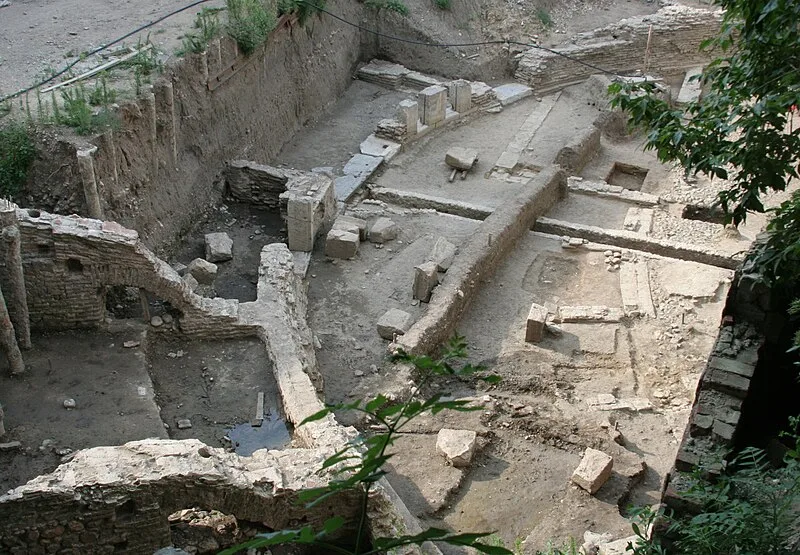
Also known as: Amfiteater Serdika, Amphitheater von Serdica, amphithéâtre de Serdica, Anfiteatro de Serdica, anfiteatro romano di Serdica, anfiteatro romano di Sofia, Arena von Serdica, Serdica Amfitiyatrosu, Софийски римски амфитеатър, セルディカの円形劇場, 塞爾迪卡競技場
| Type | Amphitheatre |
|---|---|
| Period | 1 - 500 AD |
| Country | Bulgaria |
| Coordinates | 42.6974° N, 23.3283° E |