
 Afghanistan
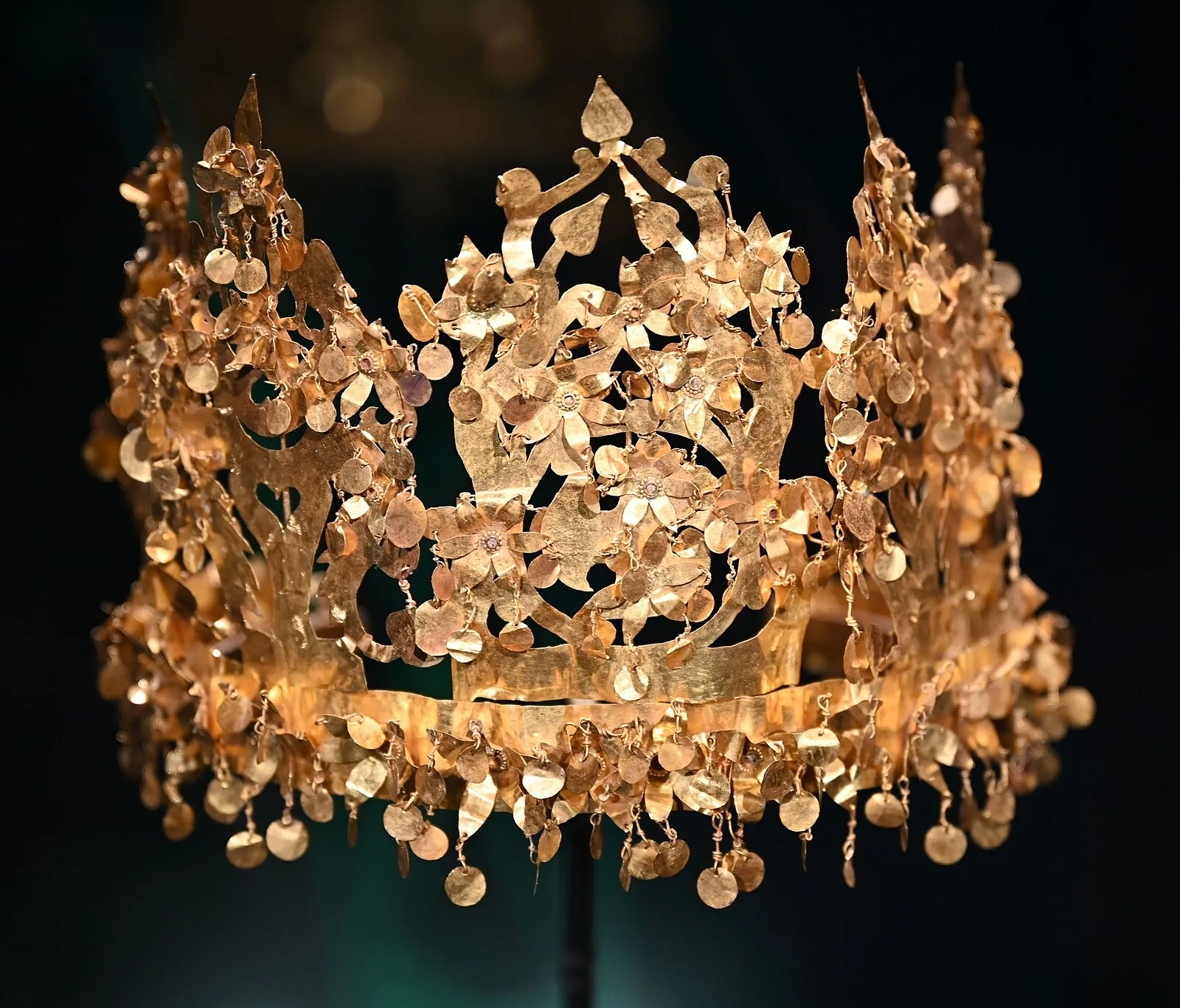
Tillya tepe, Tillia tepe or Tillā tapa is an archaeological site in the northern Afghanistan province of Jowzjan near Sheberghan, excavated in 1978 by a Soviet-Afghan team led by the Soviet archaeologist Viktor Sarianidi [1]. The hoard found there is often known as the Bactrian gold [1]. The hoard is a collection of about 20,600 ornaments, coins and other kinds of artifacts, made of gold, silver, ivory, etc., that were found in six burial mounds erected for five women and one man, with extremely rich jewelry, dated to around the 1st century BCE-1st century CE [1]. The ornaments include necklaces set with semi-precious stones, belts, medallions and a crown [1]. Several coins dated up to the early 1st century CE, with none dated later, suggest a 1st-century CE date for the burial [1]. A silver coin was found in one of the tombs from the reigns of the Parthian king Mithridates II, who ruled c. 123–88 BCE [1].
Text: Wikipedia – 'Tillya Tepe' (revision of 2026-07-18), CC BY-SA 4.0 · sentences selected and shortened by an AI system · source →Tillya Tepe
Also known as: 틸리아 테페, Tiļatepe, Tilia tepe, Tilja Tepe, Tilla tapa, Tillatepa, Tilla Tepe, Tillia Tepe, Tillja Tepe, Tilya Tepe, Τίλια Τεπέ, Тилля-тепе
| Type | Necropolis/tombs complex |
|---|---|
| Period | 1500 - 500 BC |
| Country | Afghanistan |
| Coordinates | 36.6946° N, 65.7895° E |