
 USA
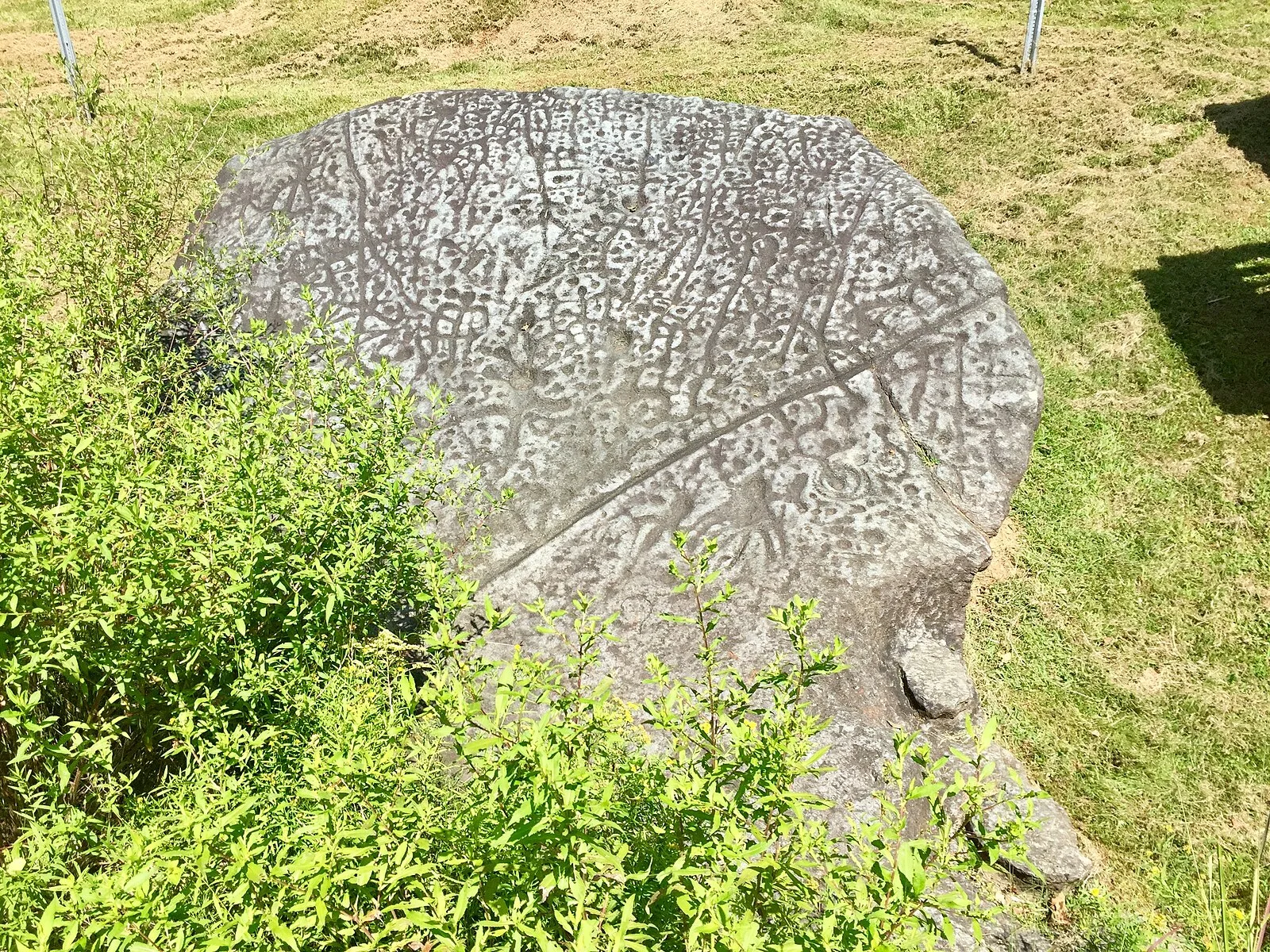
USAJudaculla Rock is a curvilinear-shaped outcrop of soapstone known for its ancient carvings and petroglyphs [1]. The petroglyph boulder occurs within a man-made bowl-shaped depression [1]. The surface of the westward-slanting main boulder is covered with petroglyphs [1]. It measures roughly 22 square meters [1]. The boulder carries scars resulting from soapstone bowl extraction [1]. The similarity between the concentric ring and cross-in-ring petroglyphs on the boulder with patterns on ceramics from the region suggests that the petroglyphs, made over the Late Archaic soapstone extraction scars, date somewhere between the Middle Woodland and late Mississippian culture periods, roughly 200 CE to 1400 CE [1]. Judaculla Rock retains a special significance for the Cherokee [1]. Judaculla Rock contains approximately 1,548 motifs [1].
Text: Wikipedia – 'Judaculla Rock' (revision of 2026-09-06), CC BY-SA 4.0 · sentences selected and shortened by an AI system · source →Judaculla Rock
| Type | Petroglyphs |
|---|---|
| Period | 3000 - 1500 BC |
| Country | USA |
| Coordinates | 35.3006° N, 83.1094° W |