
 USA
USAThe Blythe Intaglios or Blythe Geoglyphs are a group of gigantic figures incised on the ground near Blythe, California, United States, in the Colorado Desert [1]. The Blythe Intaglios contain three human figures, two four-legged animals, and a spiral; although Harner reported two spirals [1]. The largest human figure in the Blythe Intaglio group is 171 feet long [1]. The Blythe Geoglyphs or intaglios were created by scraping away layers of darker rocks or pebbles to reveal a stratum of lighter-valued soil [1]. The displaced rocks outlined the figures and the exposed soil was stamped down which makes it more difficult for plants to grow in the lines [1]. Jay von Werlhof and his collaborators obtained 13 AMS radiocarbon dates for the figures, ranging from 900 BCE to 1200 CE [1]. In 1932, George Palmer, a pilot flying between Las Vegas, Nevada and Blythe, California noticed the Blythe geoglyphs [1]. Malcolm J. Rogers subsequently studied and sketched the Blythe Intaglios in 1939 [1].
Text: Wikipedia – 'Blythe Intaglios' (revision of 2026-09-01), CC BY-SA 4.0 · sentences selected and shortened by an AI system · source →Blythe Intaglios
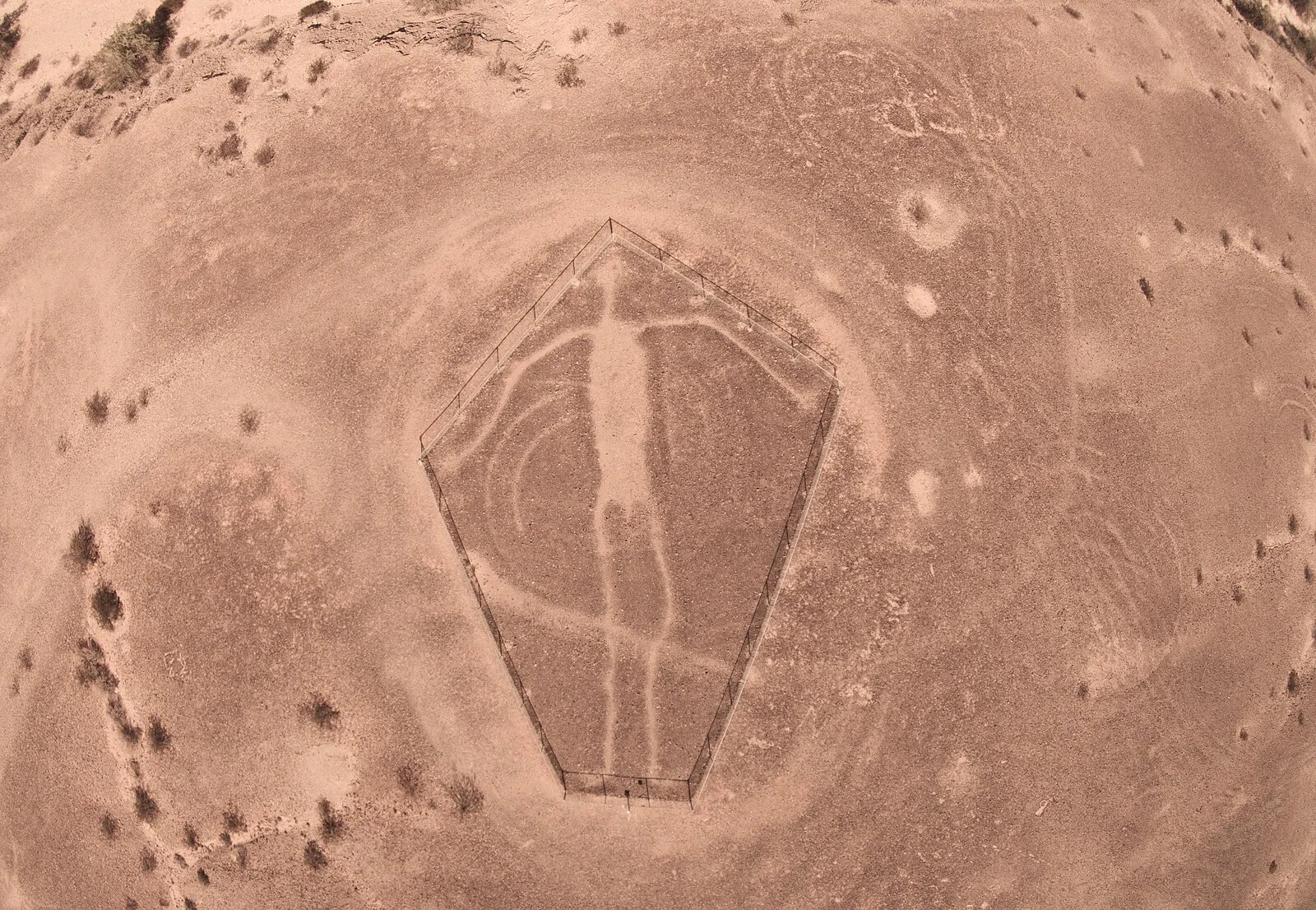
Also known as: Obrazce v Blythe, Блайтские фигуры, Блайтски инталии, Блайтські фігури, Блайцкія фігуры, Інтагліо, ブライス・インタグリオス, 布萊斯凹版
| Type | Geoglyphs |
|---|---|
| Period | 1500 - 500 BC |
| Country | USA |
| Coordinates | 33.8009° N, 114.5384° W |