
 Spain
SpainThe Antequera Dolmens Site is a cultural heritage ensemble comprising three cultural monuments (the Dolmen of Menga, Dolmen of Viera and Tholos of El Romeral) and 2 natural mountain features (the Peña de los Enamorados and El Torcal) in and near the city of Antequera in Andalusia, Spain [1]. The cultural institution responsible for its protection is the CADA [1]. It was declared a World Heritage Site in 2016 [1]. Both the Dolmen of Menga and the Tholos of El Romeral have anomalous orientations [1]. The archaeoastronomer Michael Hoskin, who studied the site, noted that, whereas the axes of almost all dolmens around the Mediterranean are oriented to a celestial feature, such as sunrise at dawn on the equinoxes (as occurs in the Dolmen of Viera), the Dolmen of Menga points to the striking nearby peak called the Peña de los Enamorados [1]. This rises abruptly from the plain and contains the contemporaneous rock shelter of Matacabras, in which cave paintings are found [1].
Text: Wikipedia – 'Antequera Dolmens Site' (revision of 2026-07-24), CC BY-SA 4.0 · sentences selected and shortened by an AI system · source →Antequera Dolmens Site
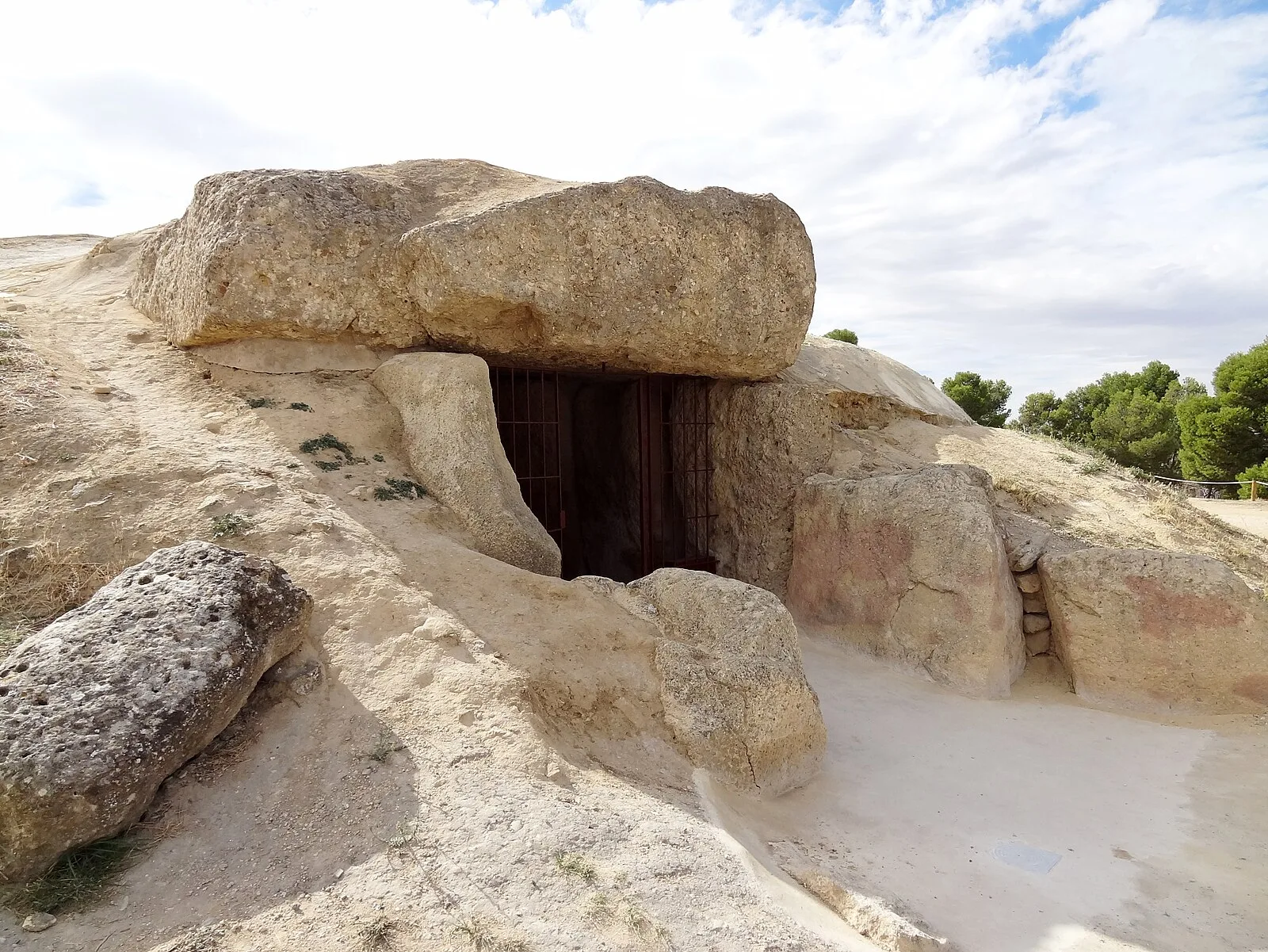
Also known as: Ámbito arqueológico de los Dólmenes de Antequera, Antekeros dolmenai, Antequera Dolmen Sitleri, Antequerako trikuharrien parajea, Conjunt arqueològic dels dòlmens d'Antequera, Conjunto dolménico de Antequera, Conjunto dolménico de Menga, Conjunto dolménico de Menga, Viera y el Romeral, Di chỉ mộ đá Antequera, Dòlmens d'Antequera, Dolmenstätten von Antequera, Dolmenstätten von Antequera World Heritage Site
| Type | Dolmen |
|---|---|
| Period | 4500 - 3000 BC |
| Country | Spain |
| Coordinates | 37.0252° N, 4.5445° W |