
 Scotland
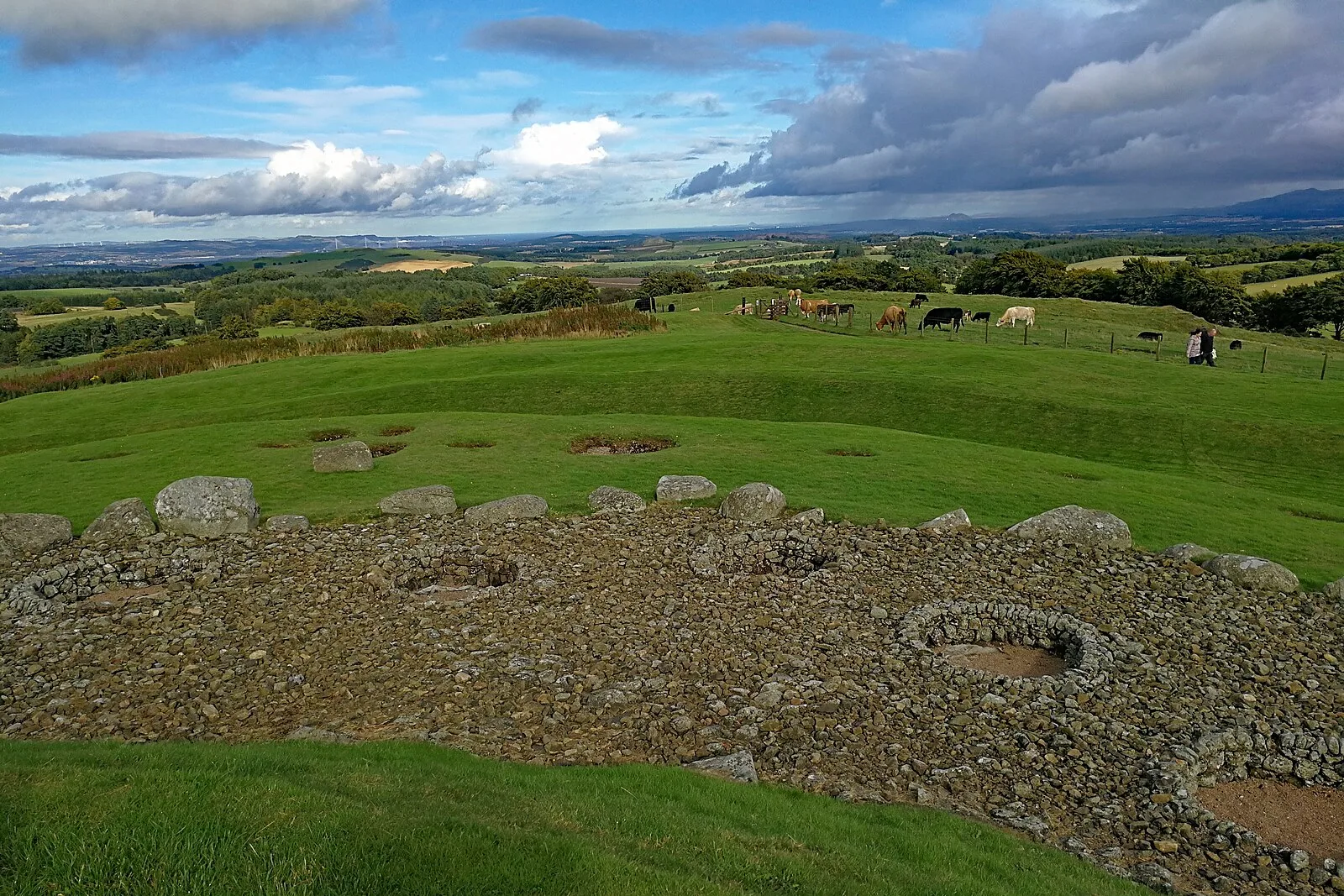
Cairnpapple Hill is a hill with a dominating position in central lowland Scotland with views from coast to coast [1]. It was used and re-used as a major ritual site for around 4,000 years [1]. In the 19th century the site was completely concealed by trees, then in 1947–1948 excavations by Stuart Piggott found a series of ritual monuments from successive prehistoric periods [1]. Neolithic rituals began around 3500 BC with signs of small hearths, and precious objects left on the hill, presumably as offerings [1]. Probably around 3000 BC a Class II henge was constructed with the hilltop being surrounded by a bank outside a ditch about 12 ft wide cut over 3 ft into the rock [1]. Some time later a Bronze Age ritual added a small stone and clay cairn just off-centre inside the monument [1]. Under the cairn traces were found of at least one burial, with wooden objects (perhaps a mask and club) and beaker people style pottery which indicates a date around 2000 BC [1].
Text: Wikipedia – 'Cairnpapple Hill' (revision of 2026-08-10), CC BY-SA 4.0 · sentences selected and shortened by an AI system · source →Cairnpapple Hill
Also known as: Cairnpapple Hill, prehistoric ceremonial complex, Кэрнпаппл-Хилл, Кэрнпэппл-Хилл, جبل كايرنپاپل هيل, ケアンパップル・ヒル, 肯帕普山
| Type | Cairn |
|---|---|
| Period | 4500 - 3000 BC |
| Country | Scotland |
| Coordinates | 55.9282° N, 3.6226° W |