
 Scotland
The Corrimony chambered cairn, located near the village of Glen Urquhart in the Highlands of Scotland, is a well-preserved Bronze Age burial monument belonging to the group of circular chambered cairns, known as Clava cairns [1]. The site was excavated by archaeologist Professor Stuart Piggott, in 1952 [1]. The historic site consists of a burial mound, edged by a stone kerb, and surrounded by a circle of 11 large stones [1]. A narrow entrance passage, 1 m in height, leads to the central chamber of the tomb [1]. The chamber was constructed from large vertical boulders and drystone walls [1]. The monument is covered by a cup-marked, single slab and piled with small stones [1]. It is thought that the large, flat stone was the original capstone [1]. During excavation, a crouched inhumation burial was found in the central chamber under a floor of flagstones [1].
Text: Wikipedia – 'Corrimony chambered cairn' (revision of 2026-07-18), CC BY-SA 4.0 · sentences selected and shortened by an AI system · source →Corrimony Chambered Cairn
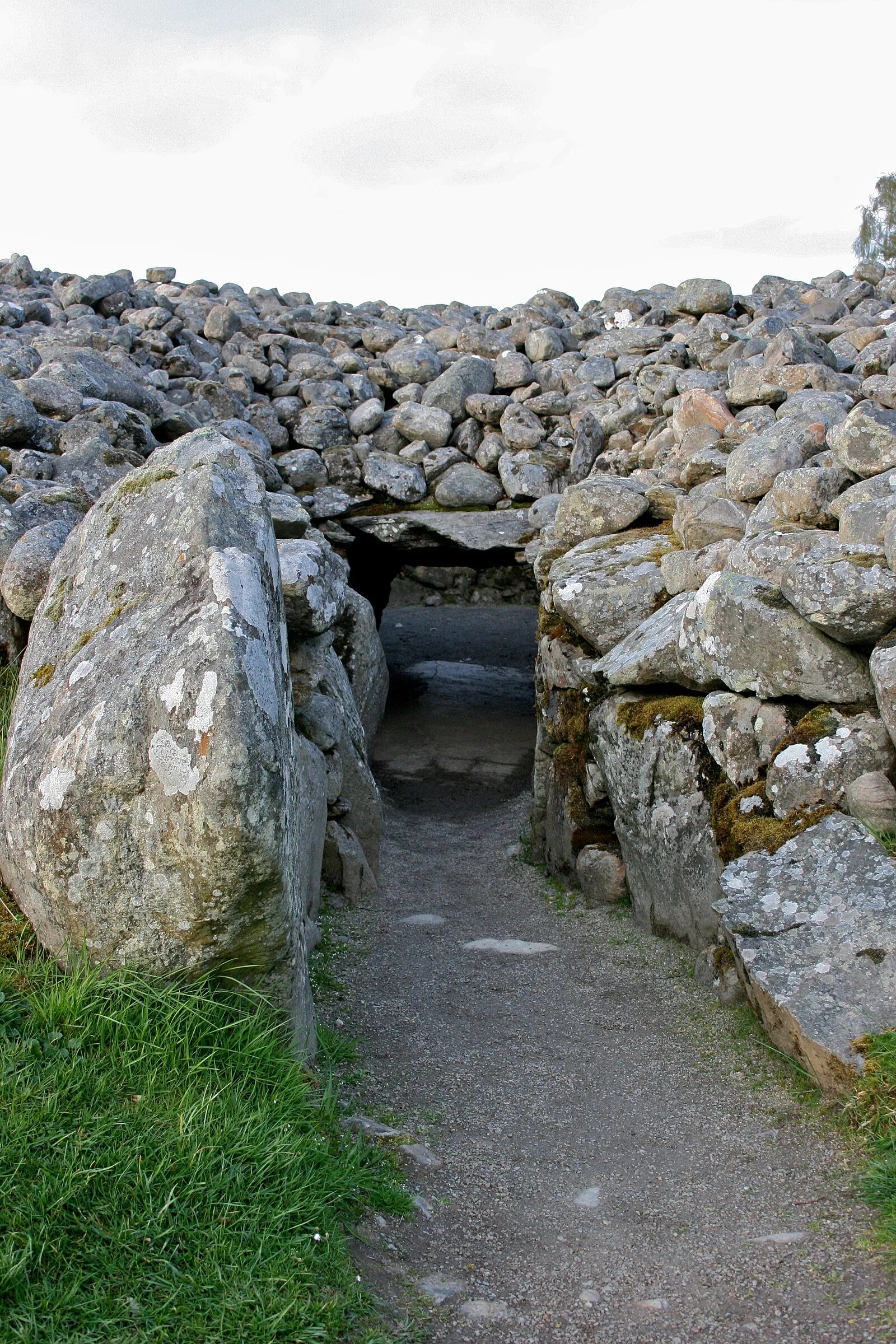
Also known as: Corrimony Cairn, Corrimony, chambered cairn 600m ESE of
| Type | Cairn |
|---|---|
| Period | 3000 - 1500 BC |
| Country | Scotland |
| Coordinates | 57.3349° N, 4.6878° W |