
 Portugal
The Fountain of the Idol is a Roman fountain located in the civil parish of São José de São Lázaro, in the municipality of Braga, northern Portugal [1]. Located in the former territory of the Callaici Bracari, the granite rock fountain/spring has Latin inscriptions, dedicated to the Gallaecian and Lusitanian gods Tongoenabiagus and Nabia [1]. The construction of the fountain probably began in the 1st century, associated with a water cult, dedicated to the Lusitanian divinity Tongoenbiagus, and ordered constructed by Celicus Fronto [1]. The fountain is a large granite surface, forming an elongated backrest, measuring about 3 metres wide and 1.20 metres high [1]. On the left of the rock is a carved human figure, about 1.10 metres tall, upright, but deteriorated, and possibly male with a beard, wrapped in a toga, holding in his left arm a bulky object [1].
Text: Wikipedia – 'Fountain of the Idol' (revision of 2026-06-12), CC BY-SA 4.0 · sentences selected and shortened by an AI system · source →Fountain of the Idol
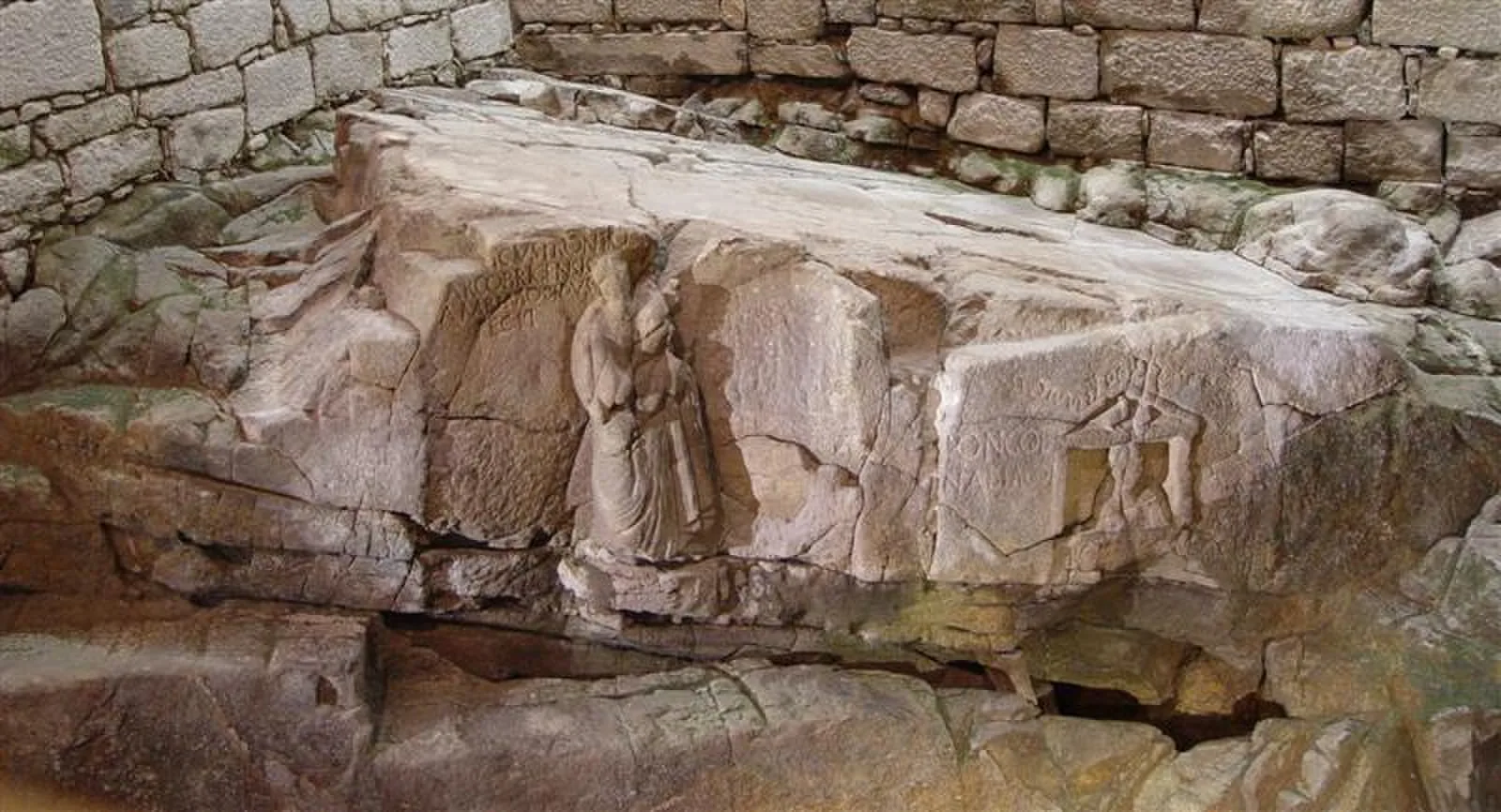
Also known as: fontaine de l'Idole, Fonte do Idolo, Fuente del Ídolo, Idol Çeşmesi, Tanque do Quintal do Ídolo
| Type | Sanctuary |
|---|---|
| Period | 1 - 500 AD |
| Country | Portugal |
| Coordinates | 41.5488° N, 8.4220° W |