
 Peru
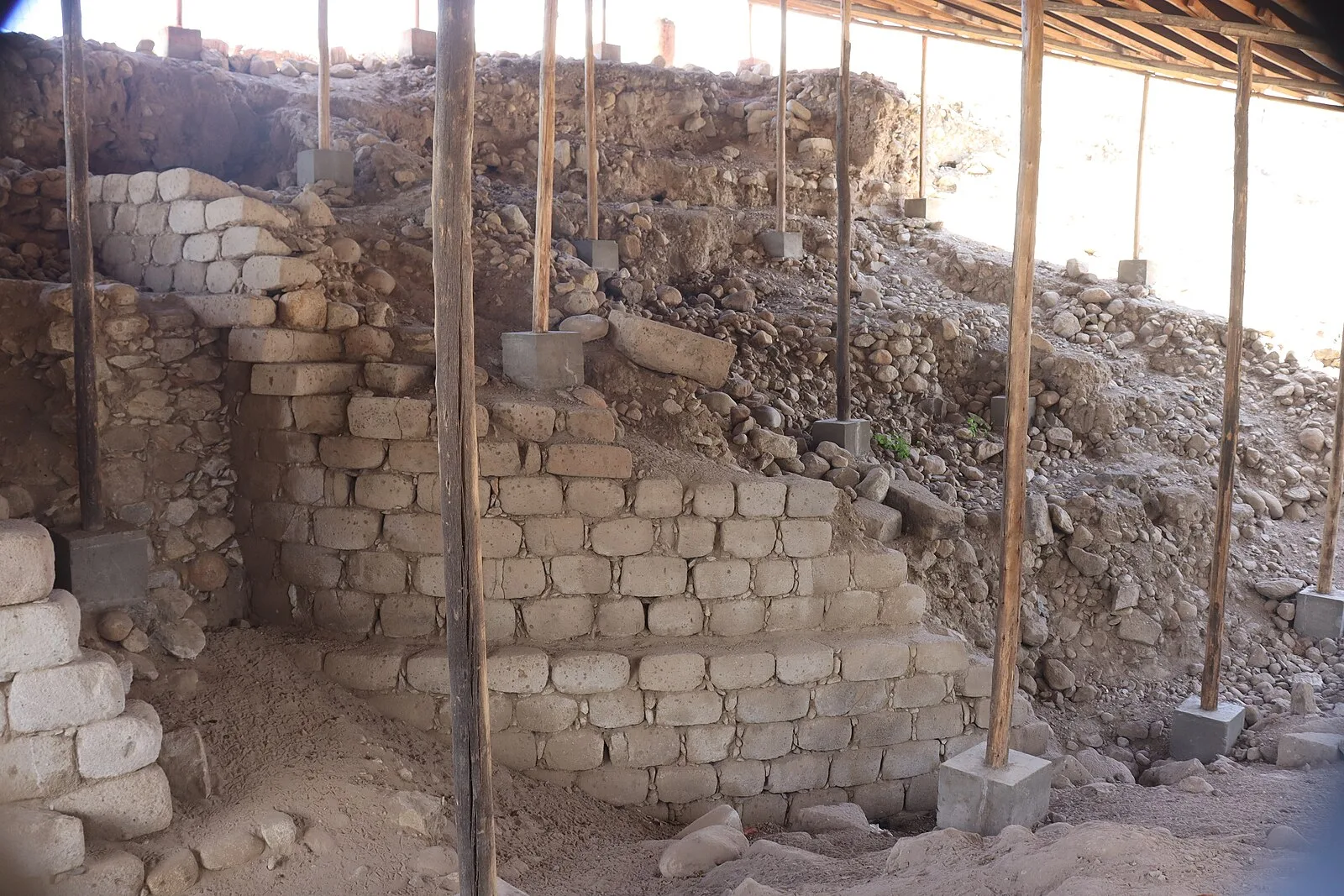
PeruTumshukayko is a pre-Inca archeological site near Caraz, Huaylas Province, Ancash Region, Peru [1]. Recent investigations suggest that the site dates from the Late Preceramic (around 2000 BCE), even though upper sediment shows evidence of a later occupation (around 300 BCE - 300 CE), perhaps by the Recuay culture [1]. Around 1873, the Italian explorer Antonio Raimondi described the location as a "hill", partially destroyed, built with huge stone walls [1]. In 1919, Dr. Julio C. Tello confirmed this description, writing that the structure includes platforms and terraces forming interior aisles and stairways [1]. Tumshukayko stands 1 km north of the present-day city of Caraz, and was apparently a center for those people living in the surrounding areas [1]. The fine stonework forms a circular structure, consisting of platforms, terraces, stairways, and lower semi-circular walls, separated by about 2.4m [1]. The most outstanding artefacts are the stone heads (cabezas clavas) and triangular stones, which are highly suggestive of a connection to the early Chavín culture [1].
Text: Wikipedia – 'Tumshukayko' (revision of 2026-06-13), CC BY-SA 4.0 · sentences selected and shortened by an AI system · source →Tumshukayko
Also known as: Tumshucaico, Tumshukaiko
| Type | Archaeological site |
|---|---|
| Period | 3000 - 1500 BC |
| Country | Peru |
| Coordinates | 9.0376° S, 77.8147° W |