
 Pakistan
Sirkap is the name of an archaeological site on the bank opposite to the city of Taxila, Punjab, Pakistan [1]. The city of Sirkap was built by the Greco-Bactrian king Demetrius after he invaded modern-day Pakistan around 180 BC [1]. The excavation of the old city was carried out under the supervision of Sir John Marshall by Hergrew from 1912–1930 [1]. Most of the discoveries at Sirkap related to the Indo-Scythian and Indo-Parthian periods (1st-2nd century CE) [1]. The site of Sirkap was built according to the "Hippodamian" grid-plan characteristic of Greek cities [1]. It is organized around one main avenue and fifteen perpendicular streets, covering a surface of around 1,200 by 400 meters, with a surrounding wall 5–7 meters wide and 4.8 kilometers long [1]. Numerous Hellenistic artifacts have been found, in particular coins of Greco-Bactrian kings and stone palettes representing Greek mythological scenes [1]. The building that is known as the Apsidal Temple is the largest sanctuary of Sirkap, measuring about 70 by 40 meters [1].
Text: Wikipedia – 'Sirkap' (revision of 2026-07-18), CC BY-SA 4.0 · sentences selected and shortened by an AI system · source →Sirkap Remains
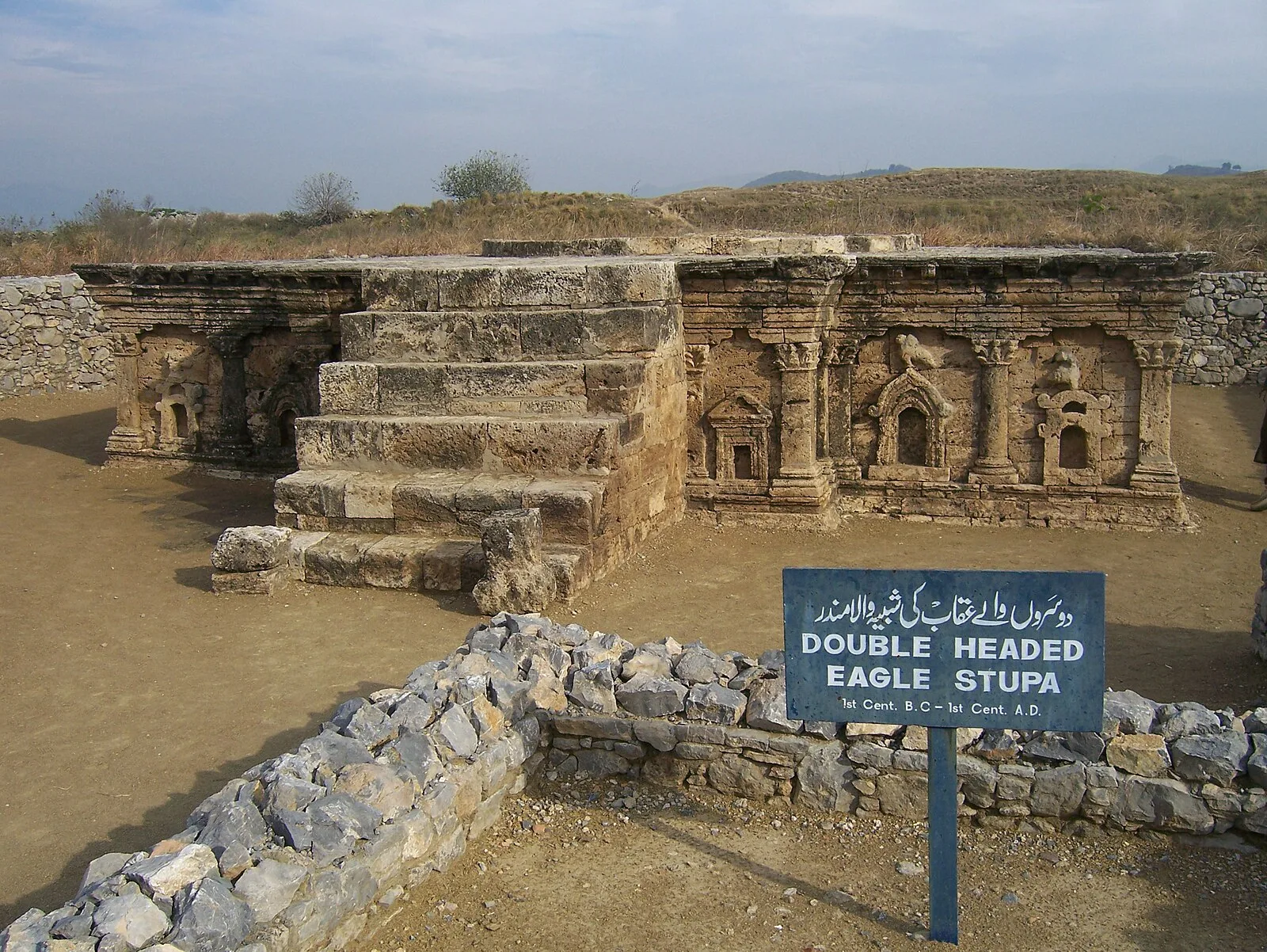
Also known as: Sircape, Sirkap, Taxila - Sirkap, סירקאפ, سركب, سرکپ, سرڪپ, சிர்காப், සිර්කප්, シルカップ, 錫爾凱波, 錫爾卡普
| Type | City/town/settlement |
|---|---|
| Period | 500 BC - 1 AD |
| Country | Pakistan |
| Coordinates | 33.7573° N, 72.8288° E |