
 Italy
ItalyTaormina's history dates to before Ancient Greece established its first colony on Sicily in 734 BCE in Magna Graecia; the Greek name for the city was Tauroménion, later Latinized to Tauromenium [1]. The present town of Taormina occupies the ancient site, on a hill that forms the last projecting point of the mountain ridge that extends along the coast from Cape Pelorus to this point [1]. The site of the old town is about 250 metres above the sea, while a very steep and almost isolated rock, crowned by a Norman castle, rises about 150 metres higher [1]. This is the likely site of the ancient Arx or citadel, an inaccessible position mentioned by ancient writers [1]. Portions of the ancient walls may be traced at intervals all round the brow of the hill, the whole of the summit of which was occupied by the ancient city [1]. Numerous fragments of ancient buildings are scattered over its surface, including extensive reservoirs of water, sepulchres, tessellated pavements, and the remains of a spacious edifice, commonly called a Naumachia [1].
Text: Wikipedia – 'Taormina' (revision of 2026-09-24), CC BY-SA 4.0 · sentences selected and shortened by an AI system · source →Taormina
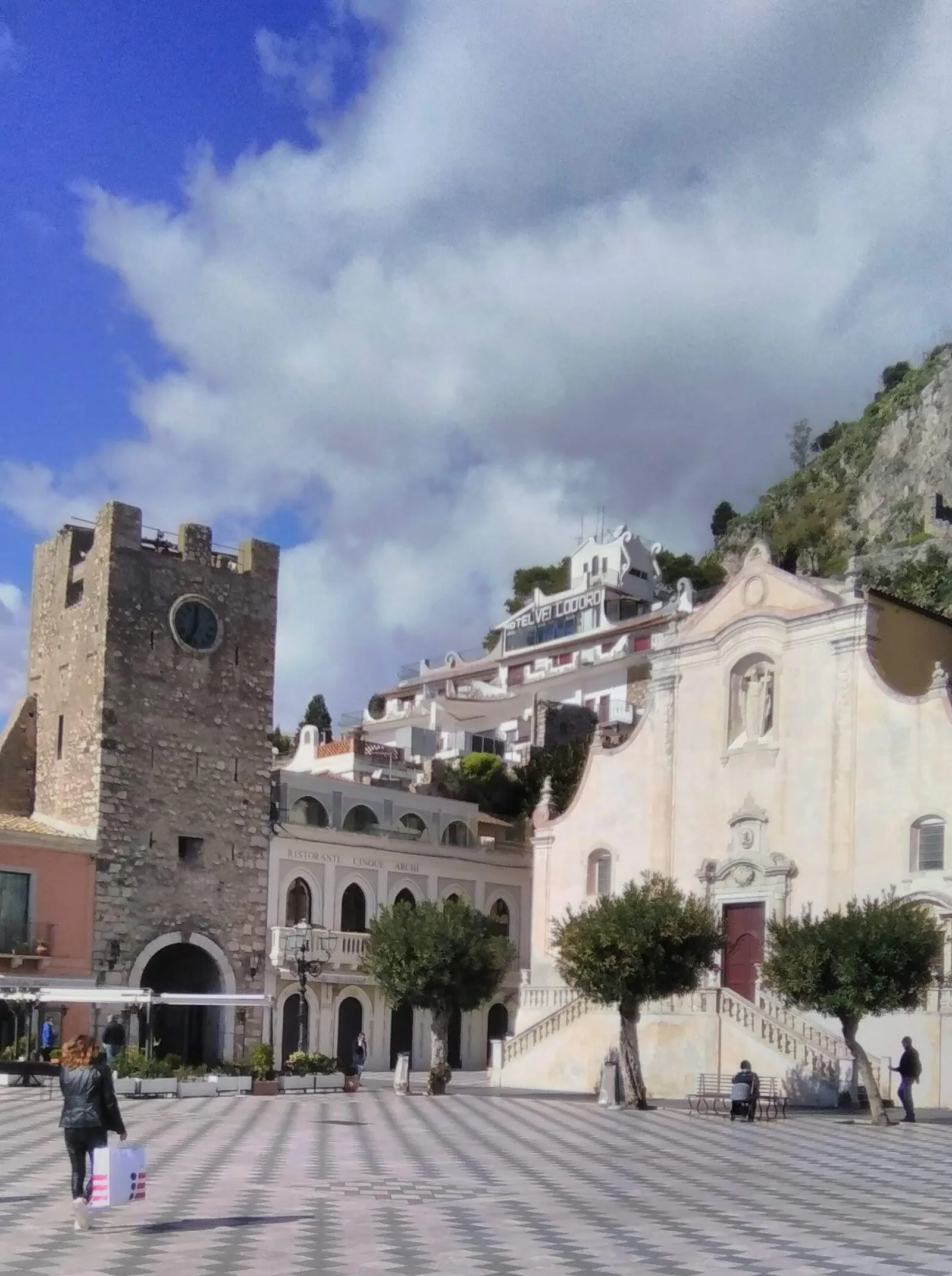
Also known as: 타오르미나, Almoezia, Tabormina, Taormina (munisipyo), Taormina (Taliansko), Taormine, Taormino, Taurmina, Tauromenio, Tauromenion, Tauromenium, Taurominium
| Type | City/town/settlement |
|---|---|
| Period | 500 BC - 1 AD |
| Country | Italy |
| Coordinates | 37.8524° N, 15.2919° E |