
 India
IndiaThe Sitabenga and Jogimara Caves, sometimes referred to either as Sitabenga Cave or Jogimara Cave, are ancient cave monuments nested in the north side of Ramgarh hills in Puta village, Chhattisgarh [1]. Dated between the 3rd-century BCE to 1st-century BCE, they are notable for their non-religious inscriptions in Brahmi script and Magadhi language, and one of the oldest colored frescoes in Asia [1]. The caves are partly natural and partly sculpted [1]. The Jogimara and Sitabenga caves are in Surguja district of Chhattisgarh, about 45 kilometers southwest of Ambikapur, 180 kilometers northeast of Bilaspur city [1]. Both caves have inscriptions [1]. According to Richard Salomon – a scholar of Indian epigraphy, Sanskrit and Buddhist studies, a paleographic analysis of these inscriptions in the pure Magadhi language suggest that they are from the 3rd-century BCE [1]. The Sitabenga cave has a two line inscription in Brahmi script close to the top of cut out wall [1]. The Jogimara cave has a five line inscription, also in Brahmi script and Magadhi language [1].
Text: Wikipedia – 'Jogimara and Sitabenga Caves' (revision of 2026-08-16), CC BY-SA 4.0 · sentences selected and shortened by an AI system · source →Jogimara Caves
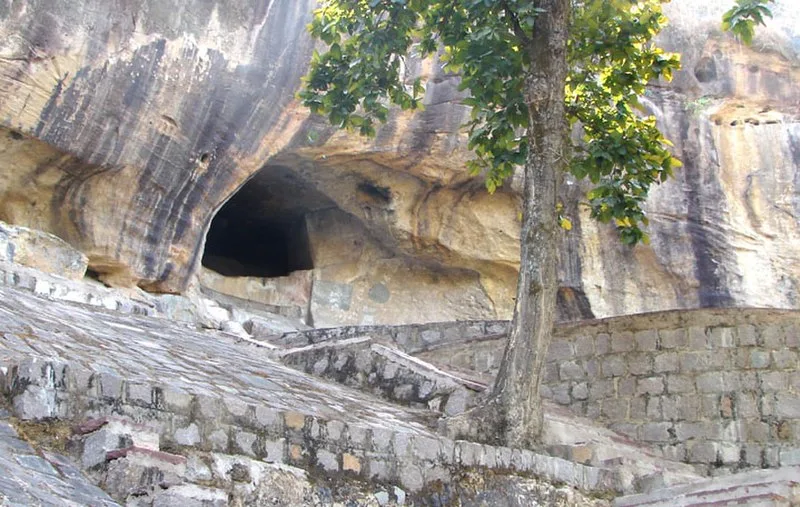
Also known as: Jogimara and Sitabenga Caves, Jogimara and Sitabenga caves, Chhattisgarh, Jogimara gufa, જોગીમારા ગુફા, జోగిమారా గుహలు
| Type | Cave Structures |
|---|---|
| Period | 500 BC - 1 AD |
| Country | India |
| Coordinates | 22.8932° N, 82.9061° E |