
 India
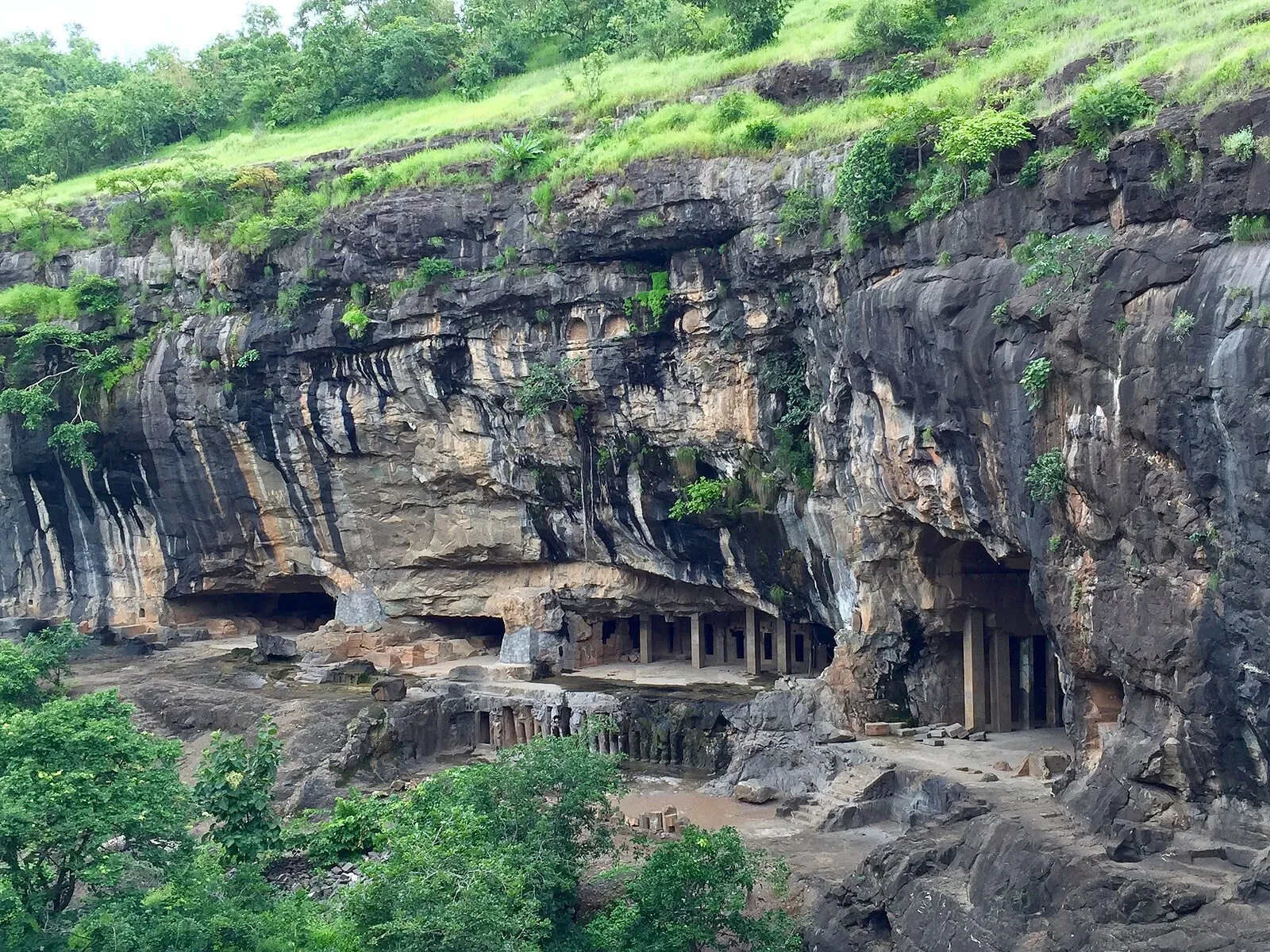
IndiaThe Pitalkhora Caves, in the Satmala range of the Western Ghats of Maharashtra, India, are an ancient Buddhist site consisting of 14 rock-cut cave monuments which date back to the third century BCE, making them one of the earliest examples of rock-cut architecture in India [1]. The caves are cut in a variety of basalt rock, but some of the caves have crumbled and are damaged [1]. Out of the 14, four are chaityas (one housing votive stupas, one apsidal and single-cell) and the rest are viharas [1]. All the caves belong to the Early Buddhist schools period, but the reasonably well preserved paintings are of the Mahayana period [1]. The caves are in two groups, one of 10 caves and the second of four [1]. It is believed that Pitalkhora can be identified with Ptolemy’s "Petrigala" as well as the "Pitangalya" of Mahamayuri, a Buddhist chronicle [1]. The inscriptions date from c. 250 BCE to the 3rd and 4th centuries CE [1]. The Chaitya hall, Cave 3 of Pitalkhora, represents an important marker in the chronology of the Chaitya hall design in western India [1].
Text: Wikipedia – 'Pitalkhora' (revision of 2026-06-29), CC BY-SA 4.0 · sentences selected and shortened by an AI system · source →Pitalkhora Buddhist Caves
Also known as: Pitalkhora, Pitalkhora Caves, Pitalkhora-Höhlen, Питхалкора, Піталкхора, מערות פיטלקורה, پیتالخورا, पितळखोरे लेणी, पीतलखोरा, ਪਿਤਲਖੋਰਾ, பிதல்கோரா குகைகள், పిటల్ఖోరా గుహలు
| Type | Cave Structures |
|---|---|
| Period | 500 BC - 1 AD |
| Country | India |
| Coordinates | 20.3140° N, 74.9931° E |