
 Greece
The Acropolis of Rhodes is the acropolis, or upper town, of ancient Rhodes dating from the 5th century BC and located 3 kilometers SW from the centre of the modern city [1]. Situated on Monte Smith overlooking the west coast of the island, the archaeological site includes some of the most important monuments in the ancient city, such as the Temple of Athena Polias and Zeus Polieus and the Temple of Apollo, below which are a stadium, an odeon and a gymnasium [1]. Unlike other acropoleis, no walled citadel was built here [1]. The city was planned in grid pattern and the upper town was no exception, though in contrast to the dense lower town there were terraced spaces of greenery according to the orator Aelius Aristides [1]. The original excavation was carried on by the Italian School of Archaeology at Athens from 1912 to 1945 [1]. Following World War II, the Greek Archaeological Service took over excavation and restoration of the ruins [1]. Mostly dating from the hellenistic period, the monuments were built on stepped terraces, with substantial retaining walls [1].
Text: Wikipedia – 'Acropolis of Rhodes' (revision of 2026-08-25), CC BY-SA 4.0 · sentences selected and shortened by an AI system · source →Acropolis of Rhodes
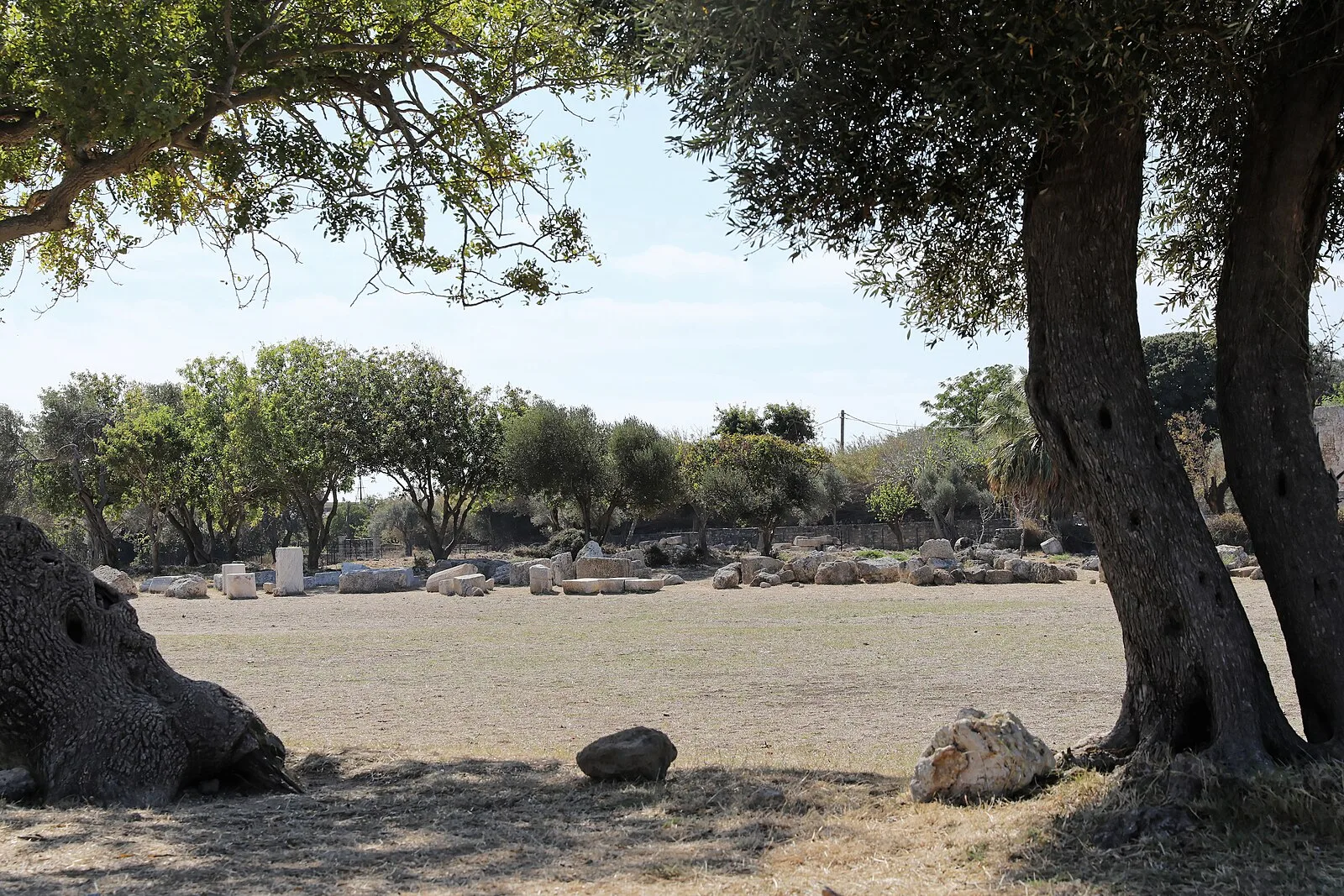
Also known as: Acropole de Rhodes, Acrópole de Rodes, Acropoli di Rodi, Acrópolis de Rodas, Akropolis von Rhodos, Antiikin Rodos, Rodos Akropolisi, Rodos Akropolü, Ακρόπολη Ρόδου, Ακρόπολη της Ρόδου, Родосский акрополь, Филеримос
| Type | Temple complex |
|---|---|
| Period | 500 BC - 1 AD |
| Country | Greece |
| Coordinates | 36.4401° N, 28.2107° E |