
 France
Bruniquel Cave is an archeological site near Bruniquel, in an area which has many paleolithic sites, east of Montauban in southwestern France [1]. Annular (ring) and accumulation (pile) structures made of broken stalagmites have been found 336 metres from the cave entrance [1]. Traces of fire were also found [1]. In a letter to Nature reporting the discovery in 2016, Jacques Jaubert and his co-authors state the structures are of anthropogenic origin, and as early Neanderthals were the only humans in the area at that time, they must have been the builders [1]. Bruniquel Cave was closed naturally during the Pleistocene [1]. The artificial ring structures made of broken stalagmites now have been dated by uranium series dating as 176.5 thousand years old [1]. Approximately 400 stalagmite pieces were used in the construction of the structure, with a total length of 112.4 metres and weight of approximately 2.2 tons [1].
Text: Wikipedia – 'Bruniquel Cave' (revision of 2026-07-18), CC BY-SA 4.0 · sentences selected and shortened by an AI system · source →Bruniquel Cave
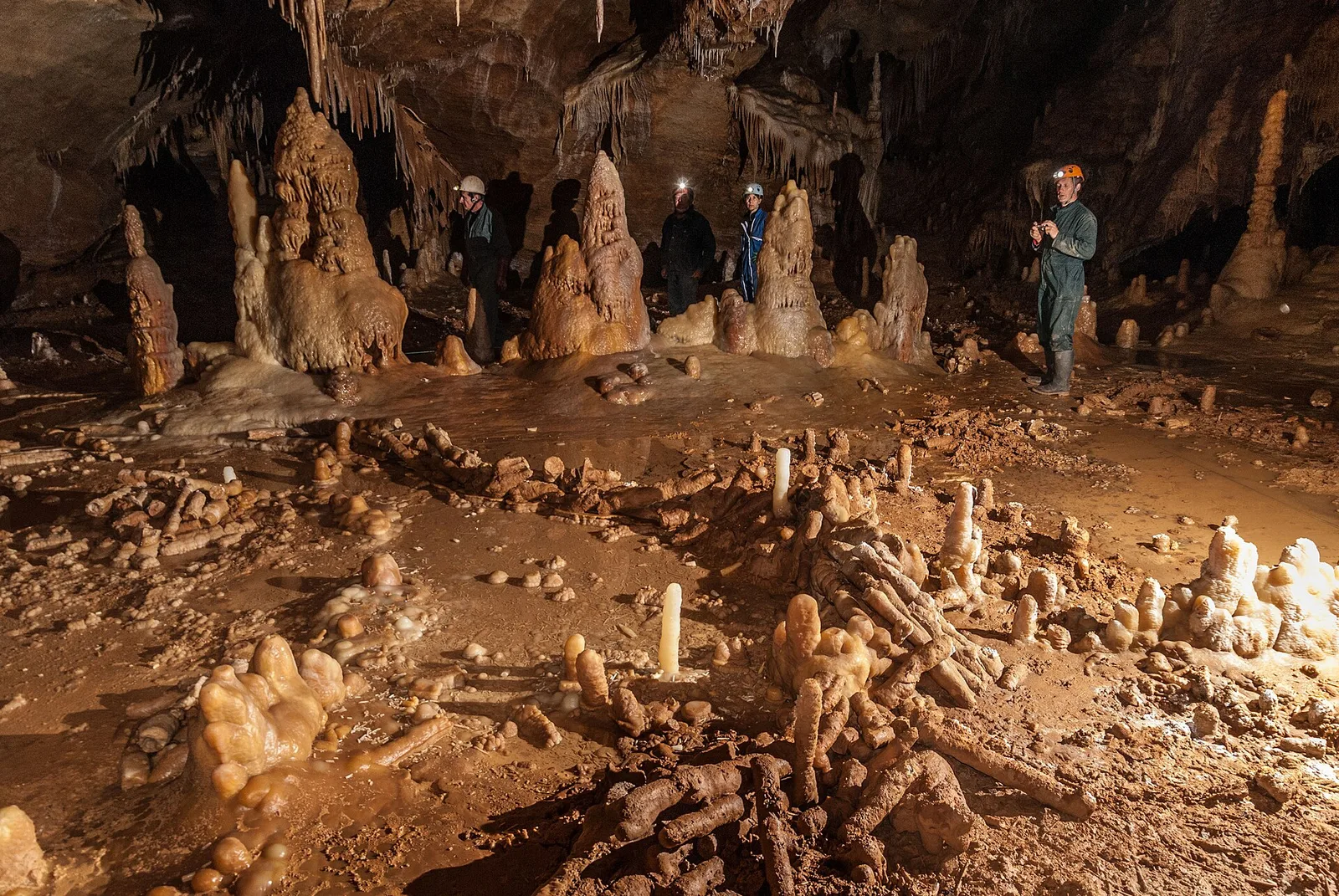
Also known as: Bruniquelgo leizea, Cauna de Borniquèl, Caverna Bruniquel, Cova de Borniquèl, Cueva de Bruniquel, Groto de Bruniquel, grotte de Bruniquel, Jaskinia Bruniquel, Steinkreise in der Höhle von Bruniquel, Брюникель (пещера), ბრუნიკელის მღვიმე, غار برونیکل
| Type | Cave Structures |
|---|---|
| Period | 500 BC - 1 AD |
| Country | France |
| Coordinates | 44.0644° N, 1.6759° E |