
 Armenia
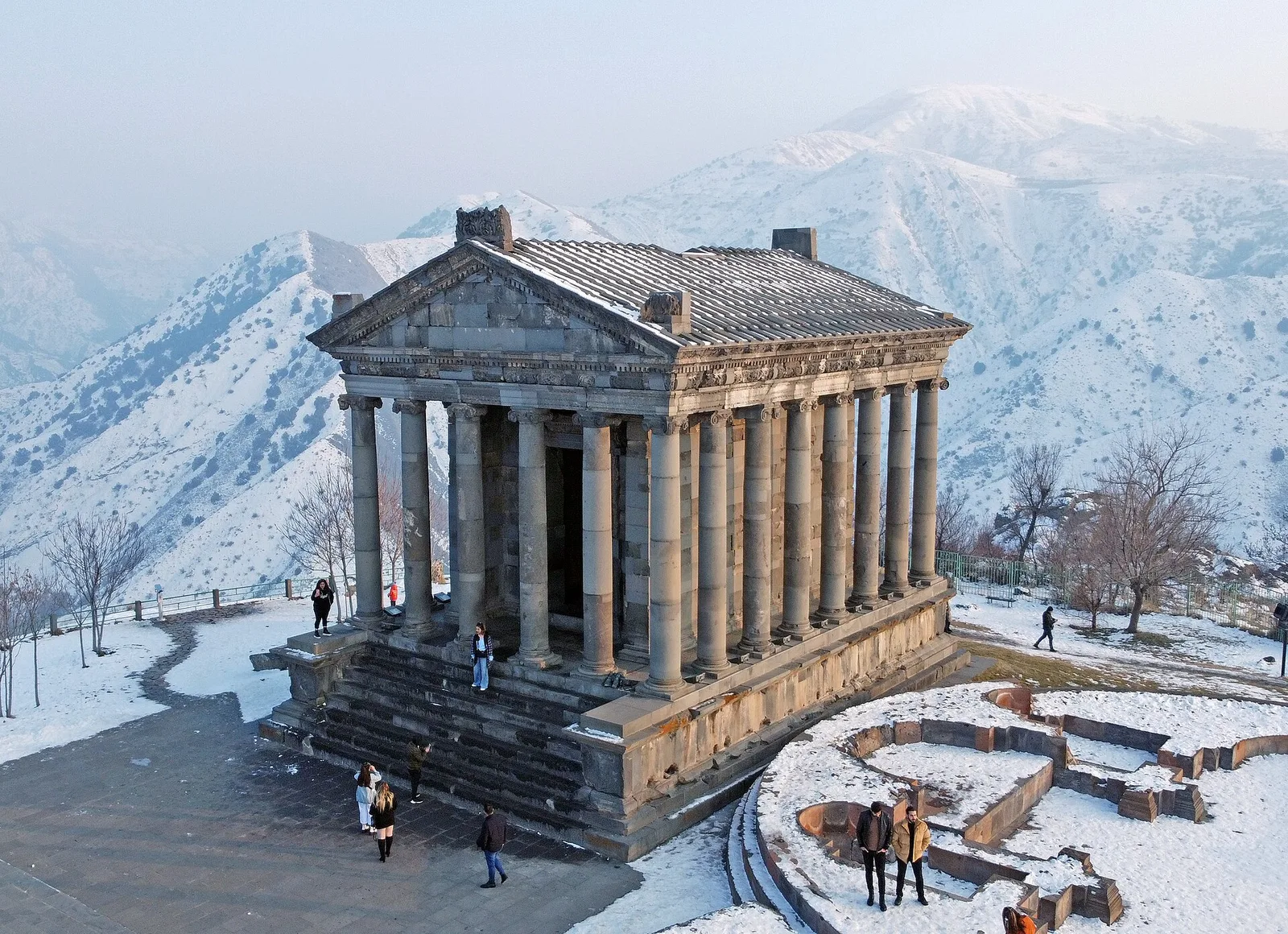
The Garni Temple is a classical colonnaded structure in the village of Garni, in central Armenia, around 30 km east of Yerevan [1]. Built in the Ionic order, it is the best-known structure and symbol of pre-Christian Armenia [1]. Considered an eastern outpost of the Greco-Roman world, it is the only largely preserved Hellenistic building in the former Soviet Union [1]. The temple is at the edge of a triangular promontory rising above the ravine of the Azat River and the Gegham mountains [1]. It is a part of the fortress of Garni, one of Armenia's oldest, that was strategically significant for the defense of the major cities in the Ararat plain [1]. The entire colonnade collapsed during a devastating earthquake on June 4, 1679, with the epicenter in the Garni Gorge [1]. The structure was rebuilt using its original stones, a technique known as anastylosis [1]. The temple is constructed of locally quarried grey to bluish basalt, assembled without the use of mortar [1].
Text: Wikipedia – 'Garni Temple' (revision of 2026-09-10), CC BY-SA 4.0 · sentences selected and shortened by an AI system · source →Garni Temple
Also known as: 가르니 신전, Chrám Garni, Chrám v Garni, Đền Garni, Garni, Garniko tenplua, Garni šventykla, Garni Tapınağı, Garni tempel, Garni templis, Gaṙnu tačar, Gərni məbədi
| Type | Temple complex |
|---|---|
| Period | 1 - 500 AD |
| Country | Armenia |
| Coordinates | 40.1128° N, 44.7308° E |