
 Türkiye
Göbekli Tepe is a Neolithic archaeological site in Upper Mesopotamia in modern-day Turkey [1]. Göbekli Tepe is near the village of Örencik in Şanliurfa Province in the Taş Tepeler, in the foothills of the Taurus Mountains [1]. Like most Pre-Pottery Neolithic sites in the Urfa region, Göbekli Tepe was built at a high point on the edge of the mountains, giving it a wide view over the plain beneath and good visibility from the plain [1]. Göbekli Tepe was built and occupied during the earliest part of the Southwest Asian Neolithic, known as the Pre-Pottery Neolithic (PPN, c. 9600–7000 BCE) [1]. The earliest phases at Göbekli Tepe have been dated to the PPNA; later phases to the PPNB [1]. Radiocarbon dating shows that the earliest exposed structures at Göbekli Tepe were built between 9500 and 9000 BCE, towards the end of the Pre-Pottery Neolithic A period [1]. Göbekli Tepe is littered with flint artifacts [1]. The stone pillars in the enclosures at Göbekli Tepe are T-shaped [1].
Text: Wikipedia – 'Göbekli Tepe' (revision of 2026-09-09), CC BY-SA 4.0 · sentences selected and shortened by an AI system · source →Göbekli Tepe
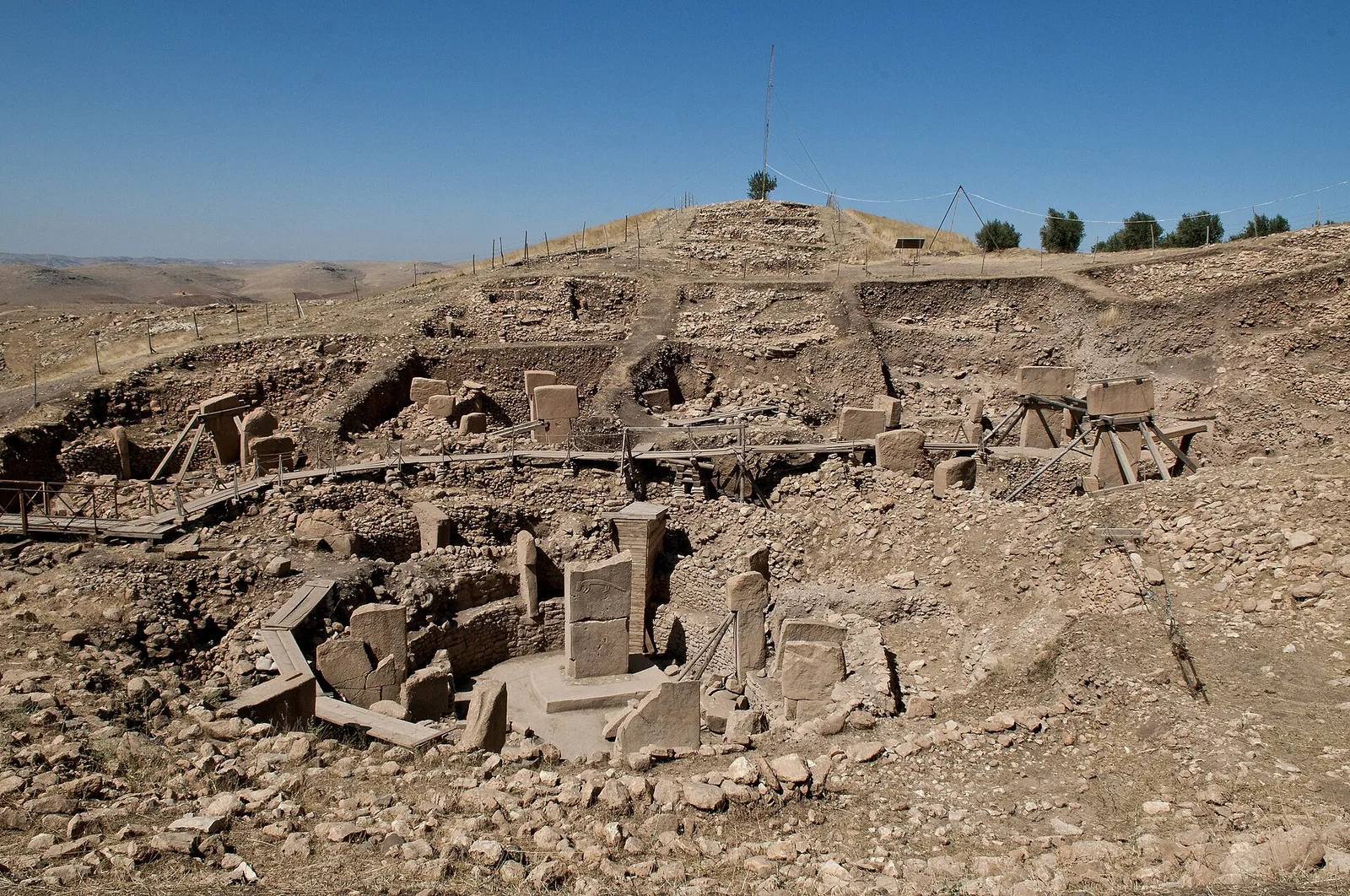
Also known as: 괴베클리 테페, Colina del Ombligo, Colina Panzuda, Gebeklitepe, Gebekli Tepe, Giobekli Tepė, Gire Mirazan, Girê Navokê, Gobeglitepe, Göbeklitepe, Göbəklitəpə, Montagne du Nombril
| Type | Megalithic structures |
|---|---|
| Period | < 4500 BC |
| Country | Türkiye |
| Coordinates | 37.2233° N, 38.9230° E |