

One of the coolest details at Göbekli Tepe: an unfinished T-shaped pillar still lying in its quarry, never levered out of the bedrock. It's about 7 m long with a 3 m wide head, 1.5 m thick, and an estimated 50 tons — bigger than the central pillars of Building D at Göbekli Tepe and Building A at Karahan Tepe. Two smaller unfinished T-pillars sit in a quarry on the southern plateau too. Mid-1990s exploration found many worked rock faces, some Roman (regular ~10 x 20 cm blocks), but most Pre-Pottery Neolithic. Maybe it was left because of a crack, or simply because it was too big 🪨🔨
Göbekli Tepe pillars cut from porous Firat limestone formation
 TürkiyeSurvey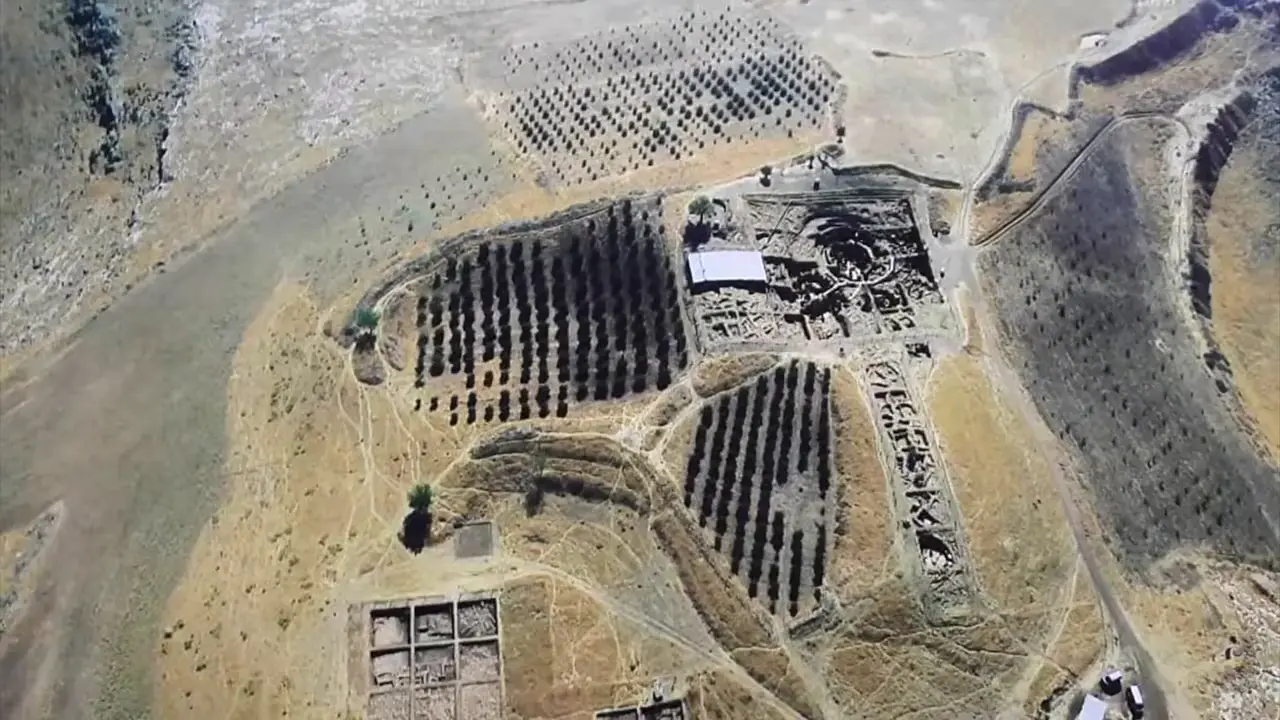
Site mentioned
Key facts
- Göbekli Tepe lies on a star-shaped limestone plateau at the highest point of the Germis mountain range in southeastern Turkey, surrounded by cliffs and steep slopes.
- An archaeological investigation of the plateau began in 1995, supplemented by geomorphological mapping in 1997 that distinguished man-made from natural features; results were published in a 2022 paper.
- Two limestone formations occur near the site: the Oligocene Gaziantep rock formation and the Early Miocene Firat formation.
- The T-pillars come from the Firat formation, the main limestone formation on which the settlement was built; it is described as medium- to thick-bedded, white to cream-coloured and porous.
- Limestone bed thickness in the Firat formation varies from 10 to 130 cm and increases toward the top of the formation.
- Profile sections along the plateau edges showed beds that are slightly inclined or near horizontal, criss-crossed by vertical and horizontal fractures.
- The limestone is described as karstified/calcified, with water dissolving the rock along cracks, joints and horizontal bedding planes, in places producing caves, sinkholes and springs.
- Quarries for the Taş Tepeler sites lie close to each settlement, with some T-pillars reaching 5.5 m (18 ft) in length, making long-distance transport impractical.
Sources
How did they do it? Making and moving monoliths at Göbekli ...dainst.blog
The T-shaped pillars discovered at Göbekli Tepe are big. The central pair of Enclosure D measure 5.5 m and weigh about 8 to 10 metric tons ...
Stones of Göbeklitepe, SE Anatolia, Turkey: an Example ...researchgate.net
The Fırat Formation (early Miocene), consisting of shelf edgebank/reef-type carbonates, displays a transgressive character from north to south ...
What Is Göbekli Tepe? Guide to the World's Oldest Monumentgobekli-tepe.com
Göbekli Tepe is a monumental archaeological site in southeastern Turkey, near the city of Şanlıurfa, dating to approximately 9,600 BCE.
Göbekli Tepe - UNESCO World Heritage Centrewhc.unesco.org
The monolithic T-shaped pillars were carved from the adjacent limestone plateau and attest to new levels of architectural and engineering technology.
An immense mystery older than Stonehengebbc.com
Gobekli Tepe was built 6,000 years before Stonehenge, and the exact meaning of its carvings – like the world the people there once inhabited – ...
Was this story useful?
Keep exploring
Every site on this page sits on the globe, and the people who research them are on the Discord.
3D Globe · Sites by country · Story Archive · Research Library · Weekly Journal · Search
AI-generated text · images from the original sources · always verify with the sources.