
 Spain
SpainThe Roman amphitheatre of Italica is a Roman amphitheatre in the Roman colonia of Italica –in present-day Santiponce, Spain–, in the Roman province of Hispania Baetica [1]. Built during the reign of emperor Hadrian, approximately between the years AD 117 and 138, it was one of the largest in the entire Roman Empire with a capacity of 25,000 spectators [1]. It was used for gladiatorial fights and combats between beasts or men and beasts during ancient Rome [1]. Italica was largely abandoned by the Romans in the 3rd century [1]. It was rediscovered during the Renaissance, in the 17th century, and work to unearth the amphitheatre began in the late 19th century [1]. Under the level of the old wooden floor of the amphitheater there was a service pit for the different gladiatorial shows and fights against wild beasts, called venatio [1]. The building was constructed using siliceous and calcareous pebbles [1]. The amphitheatre's cavea was divided into three sections, the ima, media and summa cavea, separated by annular corridors called praecinctions [1].
Text: Wikipedia – 'Roman amphitheatre of Italica' (revision of 2026-07-18), CC BY-SA 4.0 · sentences selected and shortened by an AI system · source →Roman Amphitheatre of Italica
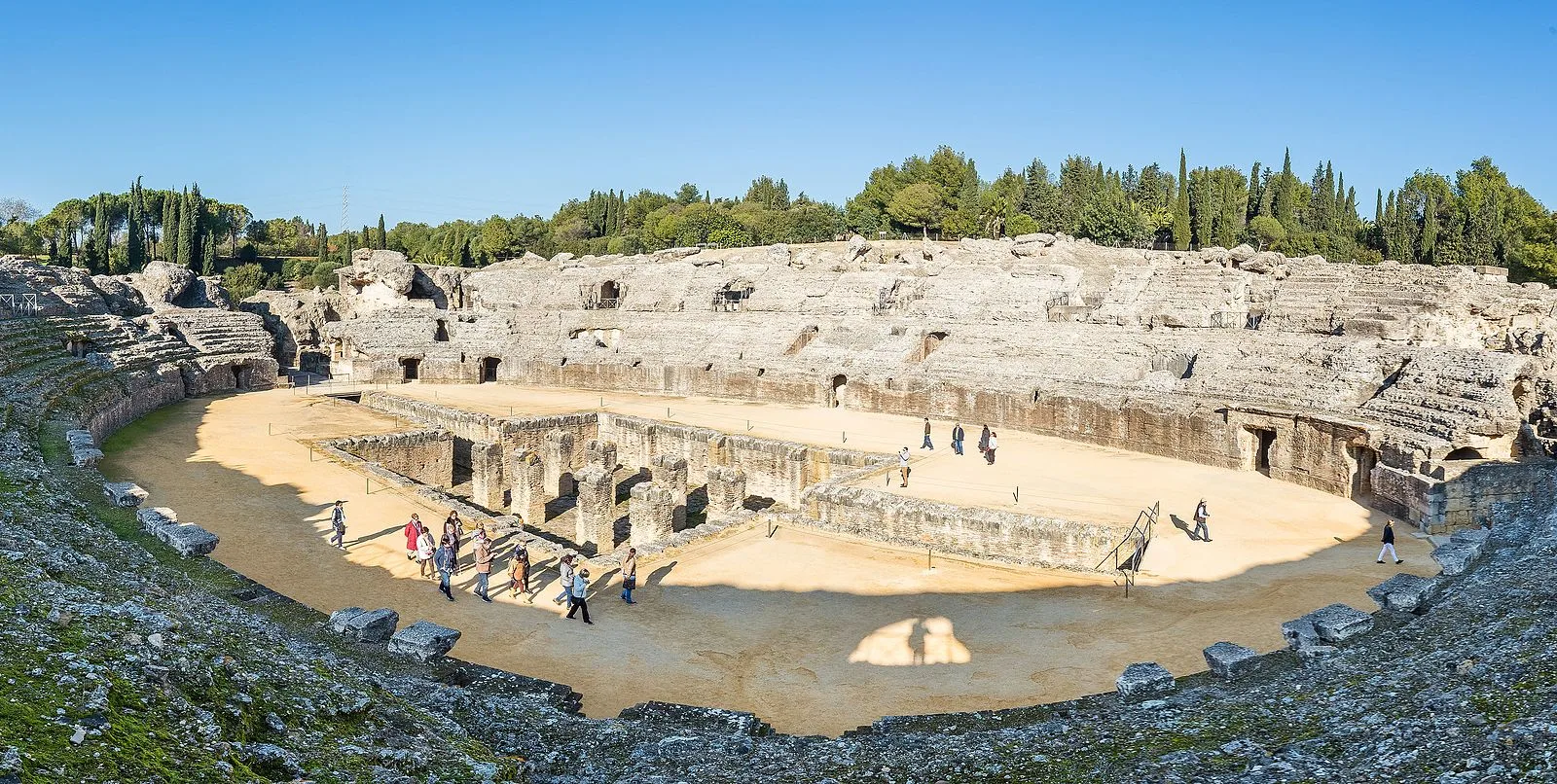
Also known as: amphithéâtre d'Italica, Amphitheatre of Italica, Anfiteatro de Italica, Anfiteatro romano di Italica, Italica Amfitiyatrosu, Italica amphitheatre, Амфітеатр, Італіка (Амфітеатр), آمفیتئاتر رومی ایتالیکا, 意大利迦罗马圆形剧场
| Type | Amphitheatre |
|---|---|
| Period | 1 - 500 AD |
| Country | Spain |
| Coordinates | 37.4441° N, 6.0466° W |