
 Spain
SpainItalica was an ancient Roman city in Hispania; its site is close to the town of Santiponce in the province of Seville, Spain [1]. It was founded in 206 BC by Roman general Scipio as a colonia for his Italic veterans and named after them [1]. The vetus urbs (original or "old" city) developed into a prosperous city and was built on a Hippodamian street plan with public buildings and a forum at the centre, linked to a busy river port [1]. Italica was important enough in late Antiquity to have a bishop of its own, and had a garrison during the Visigothic age [1]. The archaeological site of Italica encompasses mainly the nova urbs with its many fine buildings from the Hadrianic period [1]. The Traianeum was a large, imposing temple in honour of the Emperor Trajan, built by his adopted son and successor, Hadrian [1]. The aqueduct of 37 km total length was first built in the 1st c. AD and extended under Hadrian to add a more distant source for supplying the expanded city [1].
Text: Wikipedia – 'Italica' (revision of 2026-07-18), CC BY-SA 4.0 · sentences selected and shortened by an AI system · source →Italica
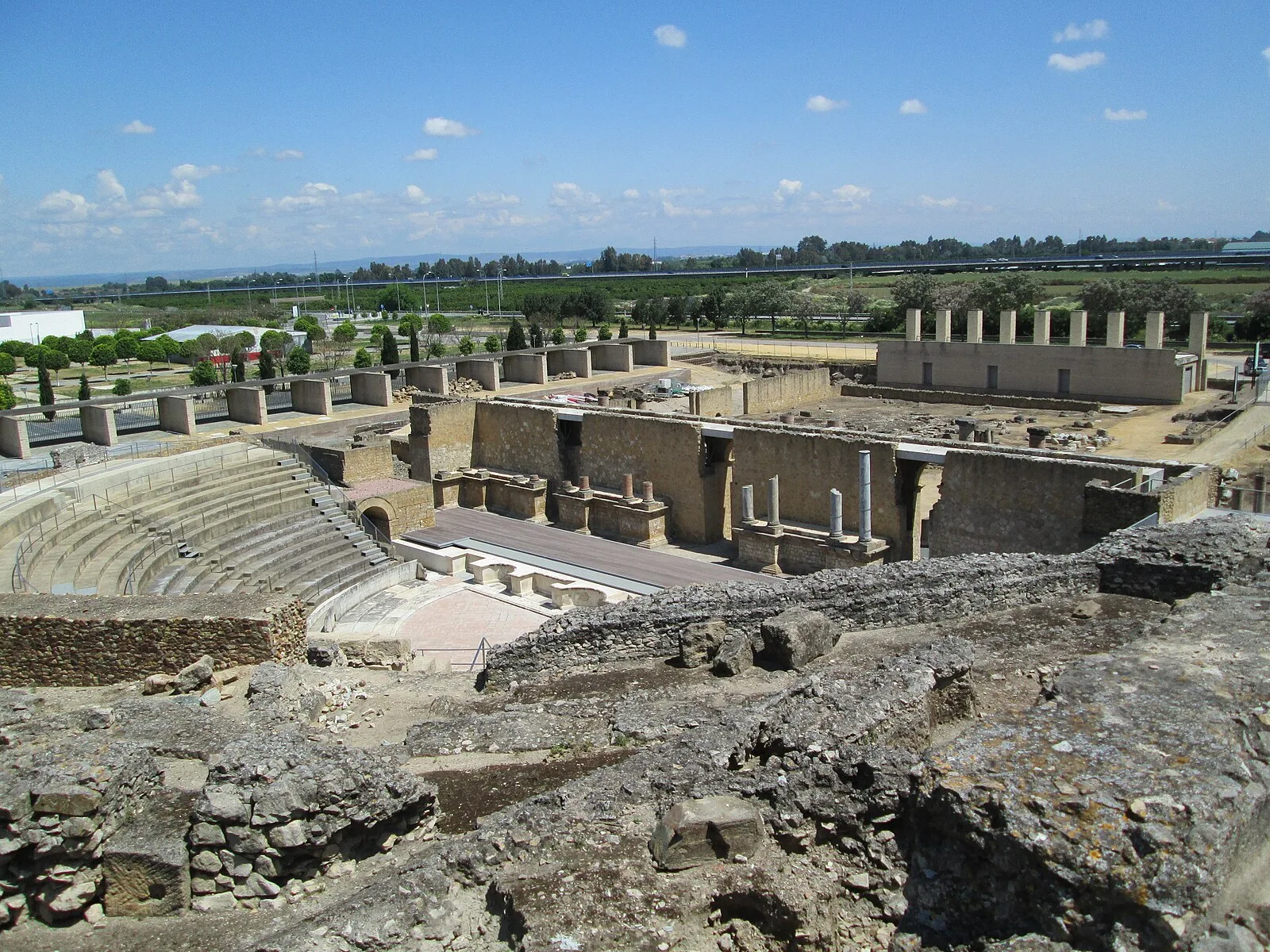
Also known as: 이탈리카, Ciudad romana de Itálica, Conjunto Arqueológico de Itálica, Itálica (cidade), Italica (Espagne), Italica (Hispania), Italika, Italiko, Ruinas de Itálica, The Hadrianic city of Italica, Ιτάλικα, Ρωμαϊκή πόλη της Ιτάλικα
| Type | City/town/settlement |
|---|---|
| Period | 500 BC - 1 AD |
| Country | Spain |
| Coordinates | 37.4440° N, 6.0466° W |