
 Mexico
La Venta is a pre-Columbian archaeological site of the Olmec civilization located in the present-day Mexican state of Tabasco [1]. La Venta was a civic and ceremonial center [1]. As a ceremonial center, La Venta contains an elaborate series of buried offerings and tombs, as well as monumental sculptures [1]. Complex C, "The Great Pyramid," is the central building in the city layout, is constructed almost entirely out of clay, and is visible from a distance [1]. One of the earliest pyramids known in Mesoamerica, the Great Pyramid is 110 ft (34 m) high and contains an estimated 100,000 cubic meters of earth fill [1]. Seventeen colossal heads have been unearthed in the Olmec area, four of them at La Venta, officially named Monuments 1 through 4 [1]. Frans Blom and Oliver La Farge made the first detailed descriptions of La Venta during their 1925 expedition, sponsored by Tulane University [1]. La Venta was first excavated by Matthew Stirling and Philip Drucker between 1940 and 1943, resulting in several articles by Stirling and in 1952 a two-volume monograph by Drucker [1].
Text: Wikipedia – 'La Venta' (revision of 2026-07-21), CC BY-SA 4.0 · sentences selected and shortened by an AI system · source →La Venta
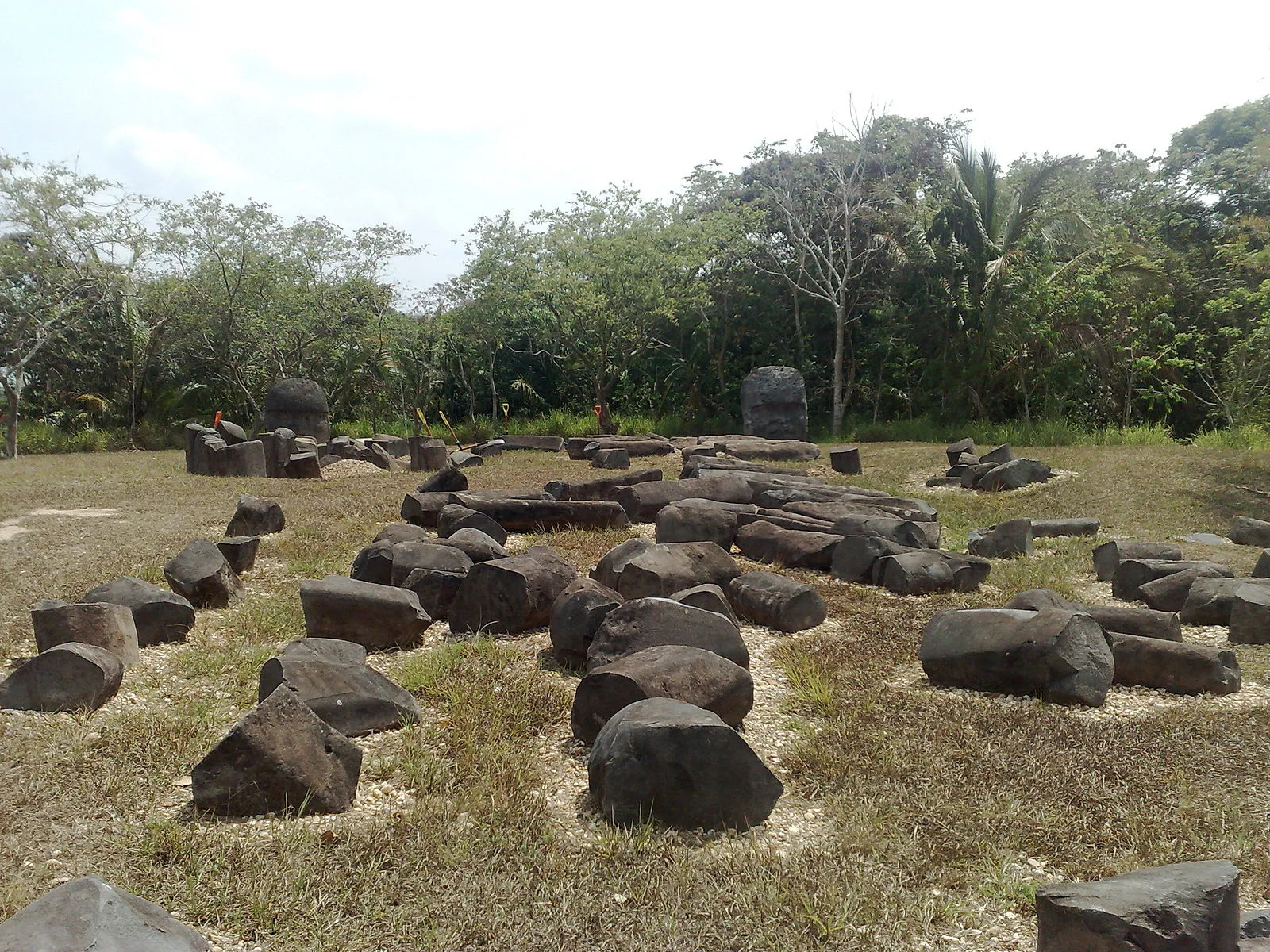
Also known as: La Venta (arkeologisk fyndplats), La Venta (Mexico), La Venta (Mexiko), La Venta (Mexique), Pyramide de La Venta, Pyramide vulcaniforme de La Venta, Sitio Arqueologico de La Venta, Zona Arqueologica de La Venta, Ла-Вента, Ла-Вента (альмекі), Ла Вента (археолошко налазиште), Ла-Вента (ольмеки)
| Type | City/town/settlement |
|---|---|
| Period | 1500 - 500 BC |
| Country | Mexico |
| Coordinates | 18.1034° N, 94.0409° W |