

La Venta's layout is precisely planned, aligned 8° west of north across ~1.5 km with 30+ earthen mounds in complexes A-I 📐. The Great Pyramid measures 128x144m at base and over 30m tall, with ~100,000 cubic meters of volume. 1990s excavations confirmed it was a stepped pyramid, not a volcano model.
La Venta's planned urban center features Great Pyramid and nine numbered complexes
 MexicoArchitecture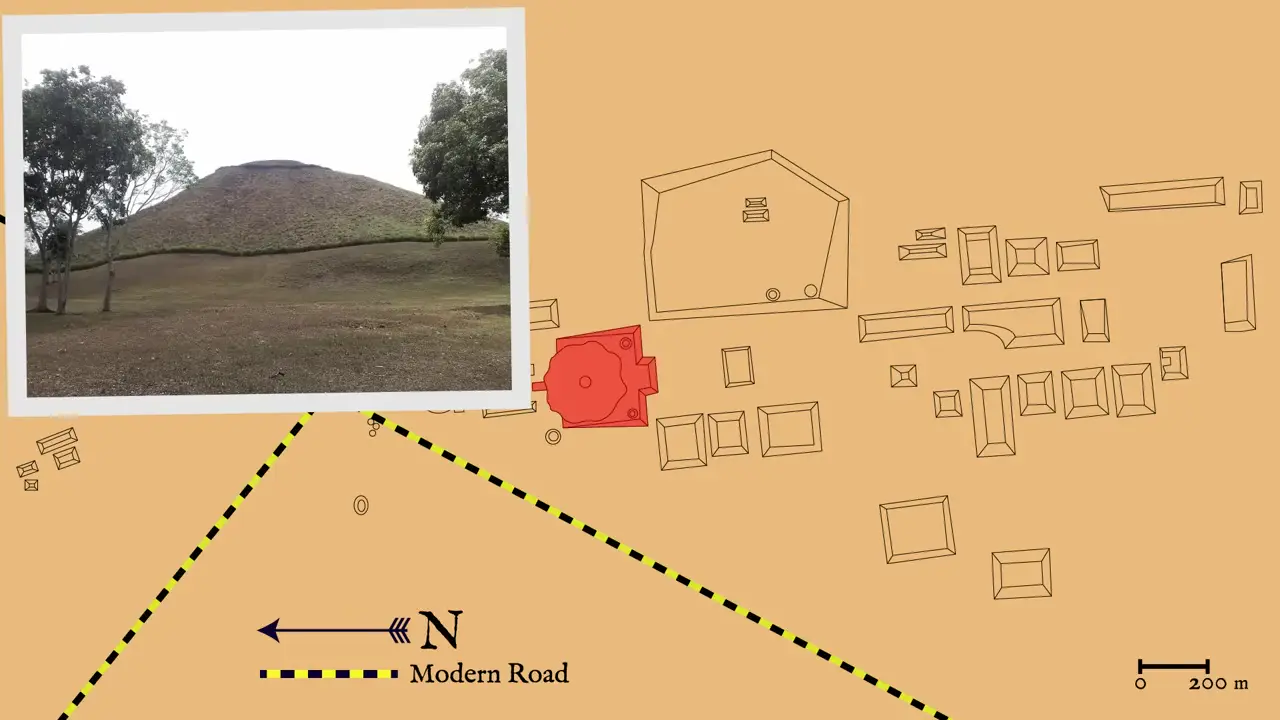
Key facts
- La Venta's layout is formally planned and aligned on an axis of 8° west of north
- The city center stretches nearly 1.5 km and contains over 30 earthen mounds and platforms divided into complexes A through I
- The Great Pyramid measures 128x144 meters at the base and over 30 meters high with a volume of almost 100,000 cubic meters, making it the largest pyramid in Mesoamerica when constructed
- Excavations in the 1990s confirmed the Great Pyramid was originally a stepped pyramid, not a volcano model
- Complex I includes three of La Venta's four colossal heads at the city's northern entrance
- Complex B south of the Great Pyramid has four mounds around a 42,000 square meter plaza
- The Sterling Acropolis, named after archaeologist Matthew Sterling, likely served as the royal palace compound
- Complex D contains an early E-Group architectural complex, though recent investigations by Takeshi Inomata suggest Nakbe (c. 950 BCE) predates La Venta's E-Group
- Two meters were bulldozed off the Great Pyramid's summit in the 1960s, destroying summit remains
Site mentioned
Sources
docs.google.com
Linked in video description
Was this story useful?
Keep exploring
Every site on this page sits on the globe, and the people who research them are on the Discord.
3D Globe · Sites by country · Story Archive · Research Library · Weekly Journal · Search
AI-generated text · images from the original sources · always verify with the sources.