
 Malta
MaltaThe Hypogeum of Ħal Saflieni is a Neolithic subterranean structure dating to the Saflieni phase (3300 – 3000 BC) in Maltese prehistory, located in Paola, Malta [1]. The Hypogeum is thought to have been a sanctuary and necropolis, with the estimated remains of more than 7,000 people documented by archeologists [1]. The Hypogeum was discovered by accident in 1902 when workers cutting cisterns for a new housing development broke through its roof [1]. The study of the structure was first conducted by Manuel Magri, who directed the excavations on behalf of the Museums Committee, starting from November 1903 [1]. During the excavations, a portion of the contents of the Hypogeum, including grave goods and human remains, were emptied out and discarded without being properly catalogued [1]. The Hypogeum is constructed entirely underground and consists of three superimposed levels hewn into soft globigerina limestone, with its halls and chambers interconnected through a labyrinthine series of steps, lintels and doorways [1].
Text: Wikipedia – 'Ħal Saflieni Hypogeum' (revision of 2026-08-11), CC BY-SA 4.0 · sentences selected and shortened by an AI system · source →Ħal Saflieni Hypogeum
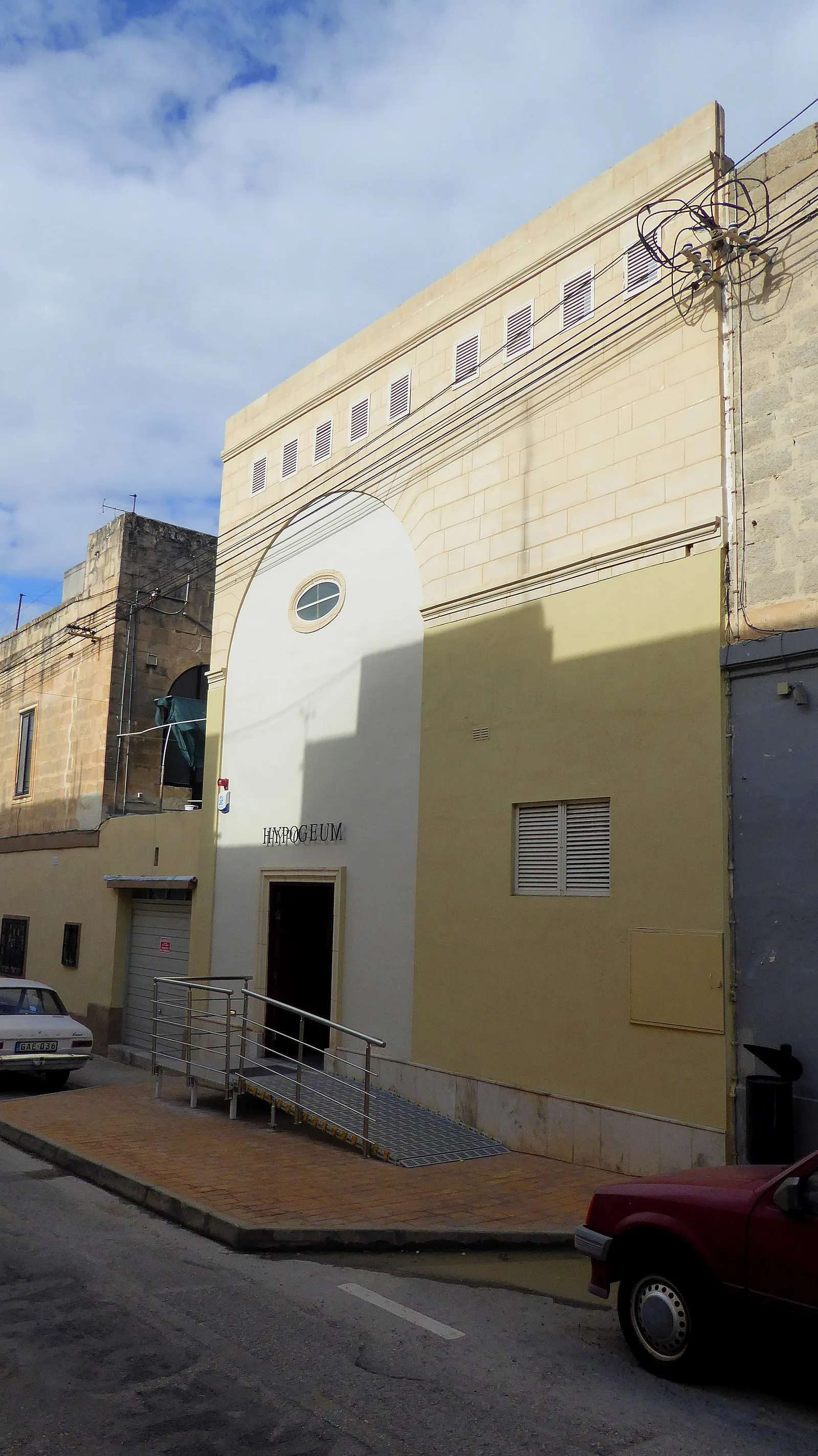
Also known as: 할사플리니 지하 묘역, Hal Saflieni, Ħal-Saflieni, Halsaflieni hipogenijs, Ħal Saflieni hüpogeum, Ħal-Saflieni Hypogeum, Hal Saflieni Hypogeum (arkiyolohiyang dapit sa Malta), Ħal Saflieni-i hipogeum, Ħal-Saflieni Katakompu, Ħal-Saflieniko hipogeoa, Hal Saflienin hypogeum, Hal Saflynio požemis
| Type | Necropolis/tombs complex |
|---|---|
| Period | 4500 - 3000 BC |
| Country | Malta |
| Coordinates | 35.8697° N, 14.5069° E |