
 Italy
ItalyThe Arch of Augustus is a monument in the city of Aosta, northern Italy [1]. It was erected in 25 BC on the occasion of the Roman victory over the Salassi and was the work of Aulus Terentius Varro Murena [1]. It is located at the end of the decumanus maximus [1]. Constructed from conglomerate, the arch has a single vault, with a height to the keystone of 11.4 metres [1]. Its span is a barrel vault, constituting an extension in width of a round arch [1]. In the monument, various styles can be recognised: The ten engaged columns which decorate its facade and its sides culminate in Corinthian capitals, while the entablature, adorned with metopes and triglyphs, is of the Doric order [1]. During the 12th century, the arch contained the home of a local noble family and in 1318 a small fortification was built inside it, designed for a corps of crossbowmen [1]. In 1716, because of the numerous leaks that were compromising the integrity of the monument, the attic that previously crowned the arch was replaced with a slate roof [1].
Text: Wikipedia – 'Arch of Augustus (Aosta)' (revision of 2025-01-31), CC BY-SA 4.0 · sentences selected and shortened by an AI system · source →Arch of Augustus
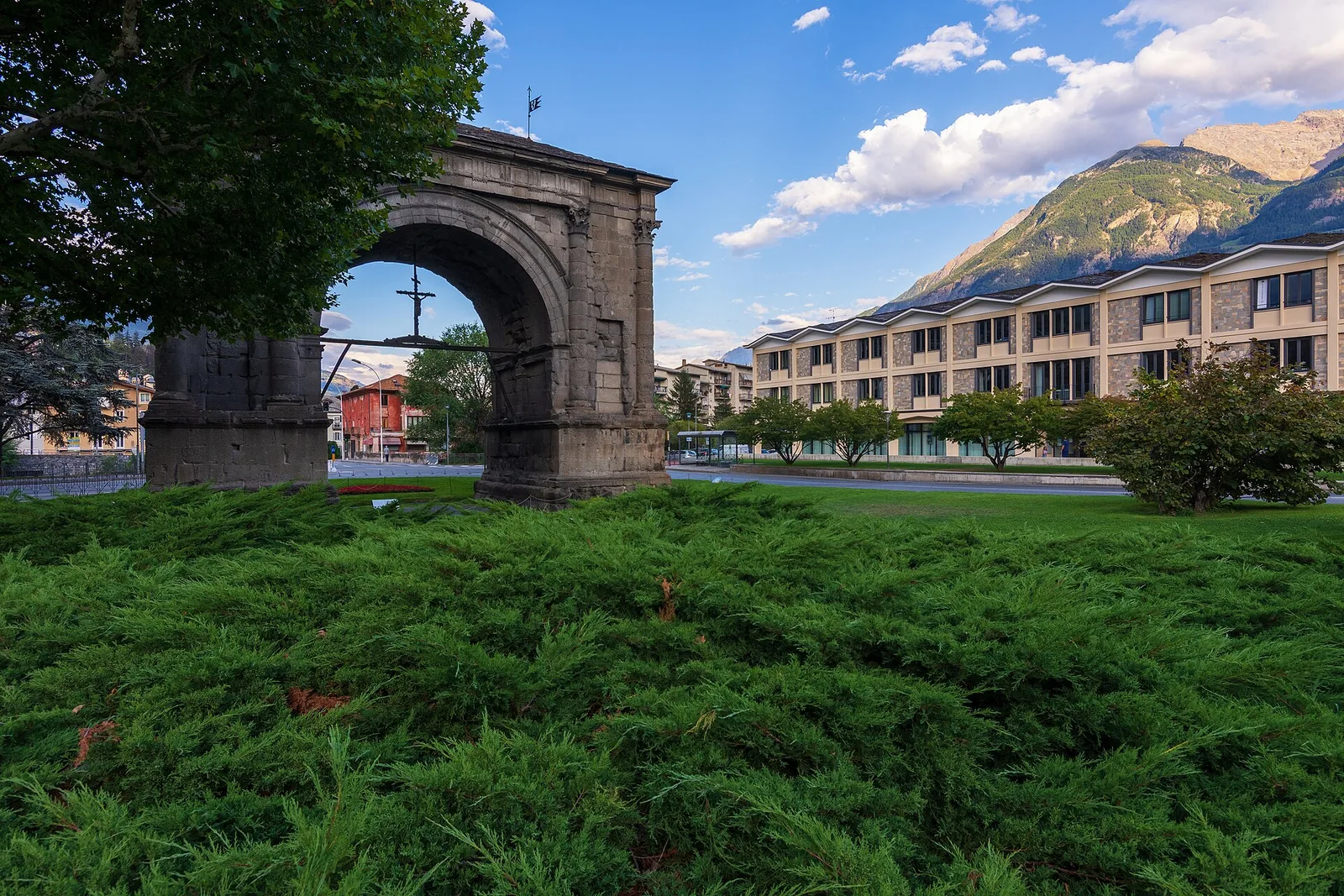
Also known as: arc d'Auguste, Arc d'Auguste (Aoste), arc d'Auguste d'Aoste, Arch of Augustus (Aosta), Arch of Augustus, Aosta, Arco d'Augusto, Arco de Augusto, Arco de Augusto (Aosta), Arco de Augusto de Aosta, Arco di Augusto (Aosta), Augustusbogen, Augustusbogen (Aosta)
| Type | Gate/archway/bridge |
|---|---|
| Period | 500 BC - 1 AD |
| Country | Italy |
| Coordinates | 45.7394° N, 7.3282° E |