
 Iran
IranThe tomb of Cyrus the Great is located in Pasargadae, which was the first capital city of his Achaemenid Empire and is now an archaeological site in the Fars Province of Iran [1]. The tomb of Cyrus is located in the southern corner of the site, which was once the royal park of Pasargadae and is built of yellowish-white limestone, probably from the Sivand mine [1]. The tomb building has been resistant to natural and unnatural factors for 2,500 years and is still standing in Pasargad plain [1]. Its main base or foundation is a stone platform whose design forms a rectangular square with a length of 13.35 m and a width of 12.3 m [1]. This building consists of two completely separate parts: a six-step stone platform, and a room with a gabled roof over the sixth step [1]. The total height of the building is a little over 11 m [1]. The design of Cyrus's tomb is credited to Mesopotamian or Elamite ziggurats, but the cella is usually attributed to Urartu tombs of an earlier period [1].
Text: Wikipedia – 'Tomb of Cyrus the Great' (revision of 2026-07-22), CC BY-SA 4.0 · sentences selected and shortened by an AI system · source →Tomb of Cyrus the Great
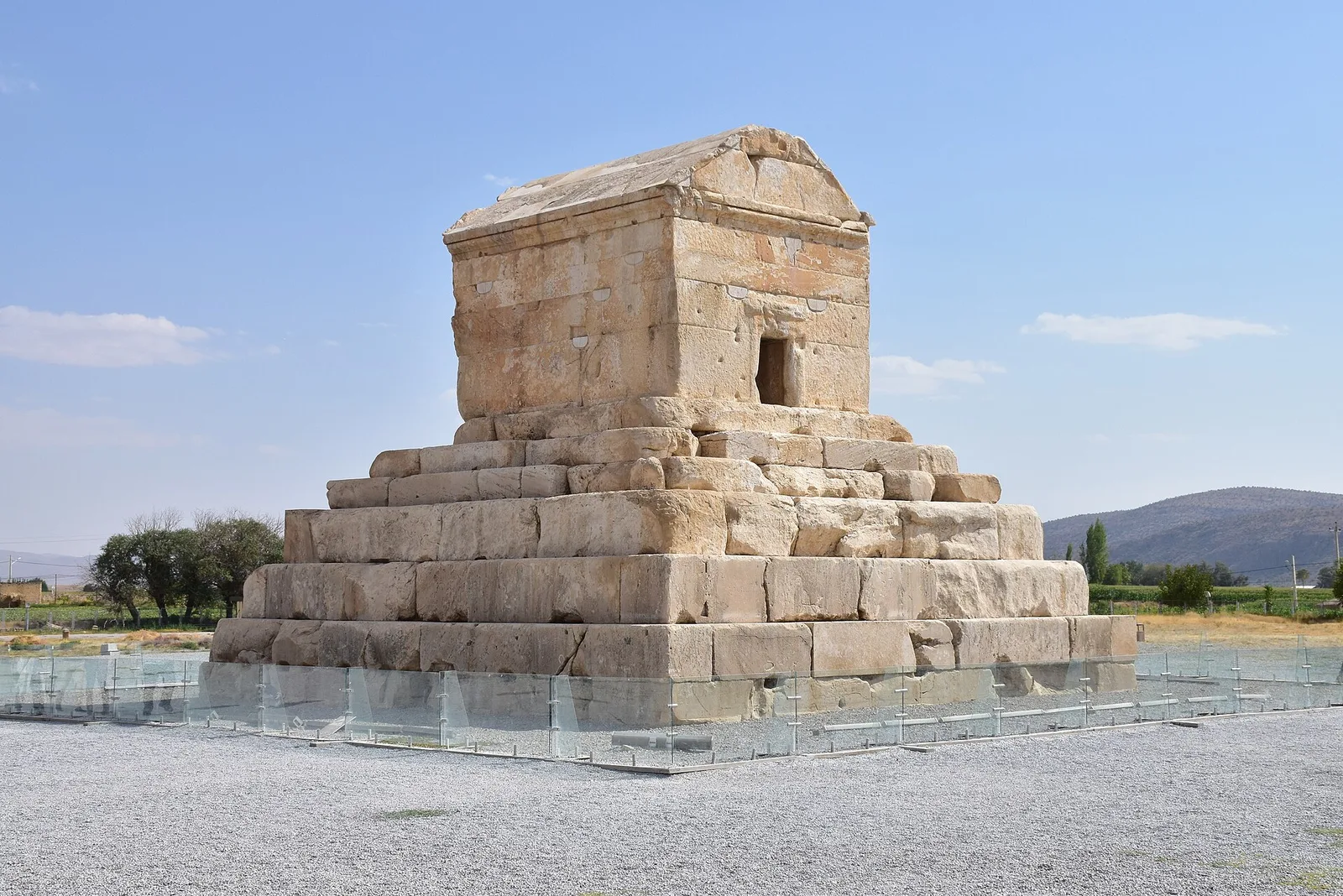
Also known as: 키루스의 무덤, 키루스 묘, 키루스 묘소, Bedh Cyrus, Cyres Eorþærn, Grabmal des Kyros II., Grób Cyrusa II Wielkiego, grobnica Kira Velikega, Grobowiec Cyrusa II, hrobka Kýra II., hrobka Kýra Velikého, Kiros'un Mezarı
| Type | Necropolis/tombs complex |
|---|---|
| Period | 1500 - 500 BC |
| Country | Iran |
| Coordinates | 30.1942° N, 53.1680° E |