
 Greece
Tiryns is a Mycenaean archaeological site in Argolis in the Peloponnese [1]. Tiryns was a hill fort with occupation ranging back seven thousand years, from before the beginning of the Bronze Age [1]. It reached its height of importance between 1400 and 1200 BC, when it became one of the most important centers of the Mycenaean world, and in particular in Argolis [1]. Its most notable features were its palace, its Cyclopean tunnels and especially its walls, which gave the city its Homeric epithet of "mighty walled Tiryns" [1]. In c. 1300 BC, the citadel and lower town had a population of 10,000 people covering 20–25 hectares [1]. Despite the destruction of the palace in c. 1200 BC, the city population continued to increase and by 1150 BC it had a population of 15,000 people [1]. In the post-palatial LH IIIC period (c. 1180 BC), an extensive deposit of precious items, including gold and silver objects and a fifteenth-century BC Minoan signet ring, was made in a cauldron in Tiryns's lower town [1].
Text: Wikipedia – 'Tiryns' (revision of 2026-08-28), CC BY-SA 4.0 · sentences selected and shortened by an AI system · source →Tiryns
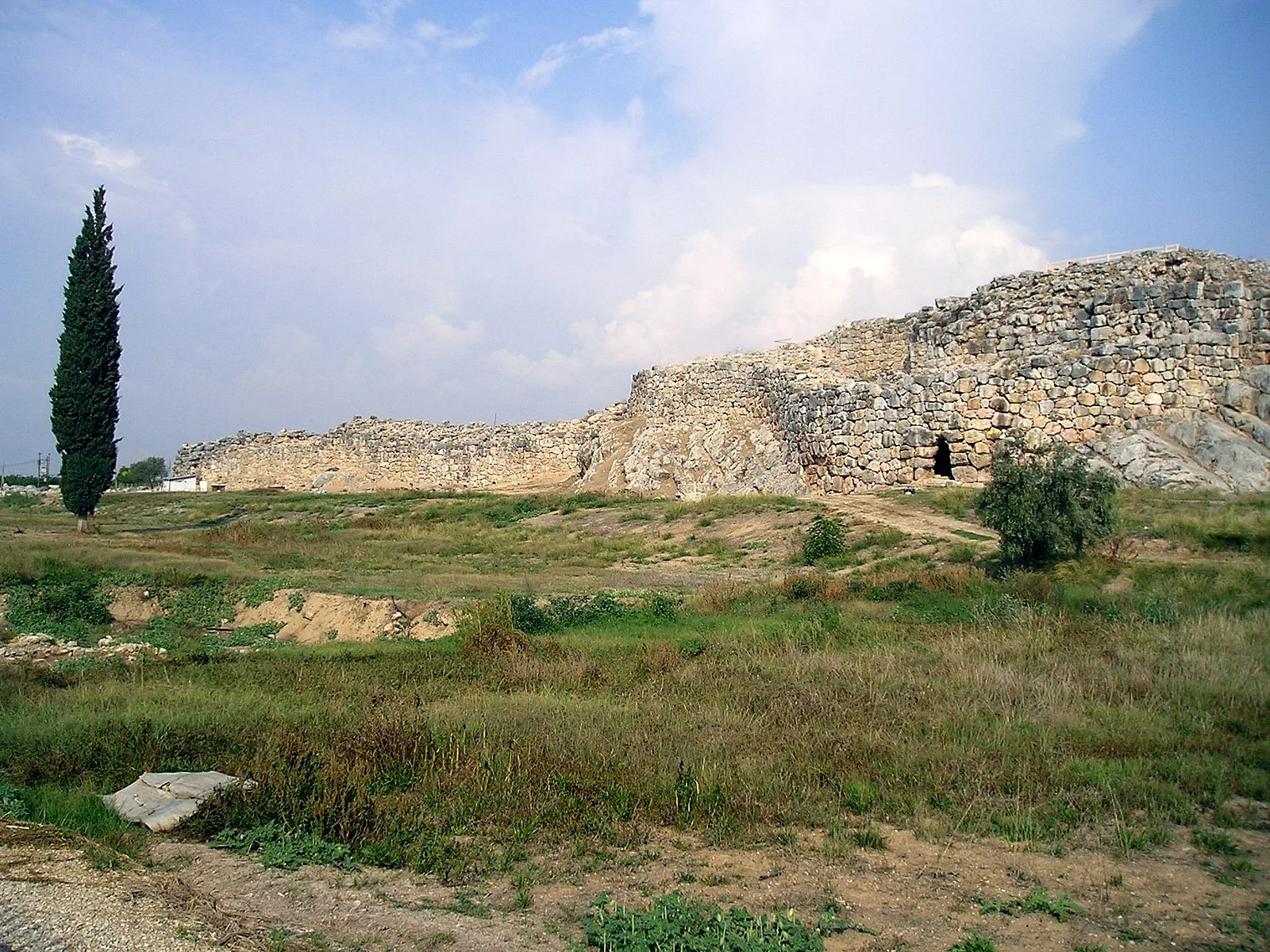
Also known as: 티린스, archaeological site of Tiryns, Mint of Tiryns, sito archeologico di Tirinto, Tirinos, Tirins, Tirint, Tīrinta, Tirintas, Tirinte, Tirinti, Tirinto
| Type | Fortress/citadel |
|---|---|
| Period | < 4500 BC |
| Country | Greece |
| Coordinates | 37.5997° N, 22.7999° E |