
 Greece
The Treasury of Atreus is the largest and most elaborate of the known Mycenaean tholos tombs [1]. It follows the typical tripartite division of these tombs into a narrow rectangular passageway (dromos), joined by a deep doorway (stomion) to a burial chamber (thalamos) surmounted by a corbelled dome [1]. The dome was covered with earth to heighten it; some of this mound remains, but erosion has reduced its height and moved its apex towards the west [1]. The dromos of the tomb is oriented east-west and is 36 m long by 6 m wide [1]. For the first 19 metres from the stomion, the sides are dressed with conglomerate stone walls: while the dromoi of earlier tombs had been lined with rubble or poros ashlar, the Treasury of Atreus is the first tomb at Mycenae to be fully lined with conglomerate [1]. The Treasury of Atreus is set alone at the southern edge of a bowl on the Panagia ridge's eastern slope [1]. The first securely-documented entrance to the tomb was undertaken by the British aristocrat Thomas Bruce, 7th Earl of Elgin [1].
Text: Wikipedia – 'Treasury of Atreus' (revision of 2026-07-19), CC BY-SA 4.0 · sentences selected and shortened by an AI system · source →Treasury of Atreus
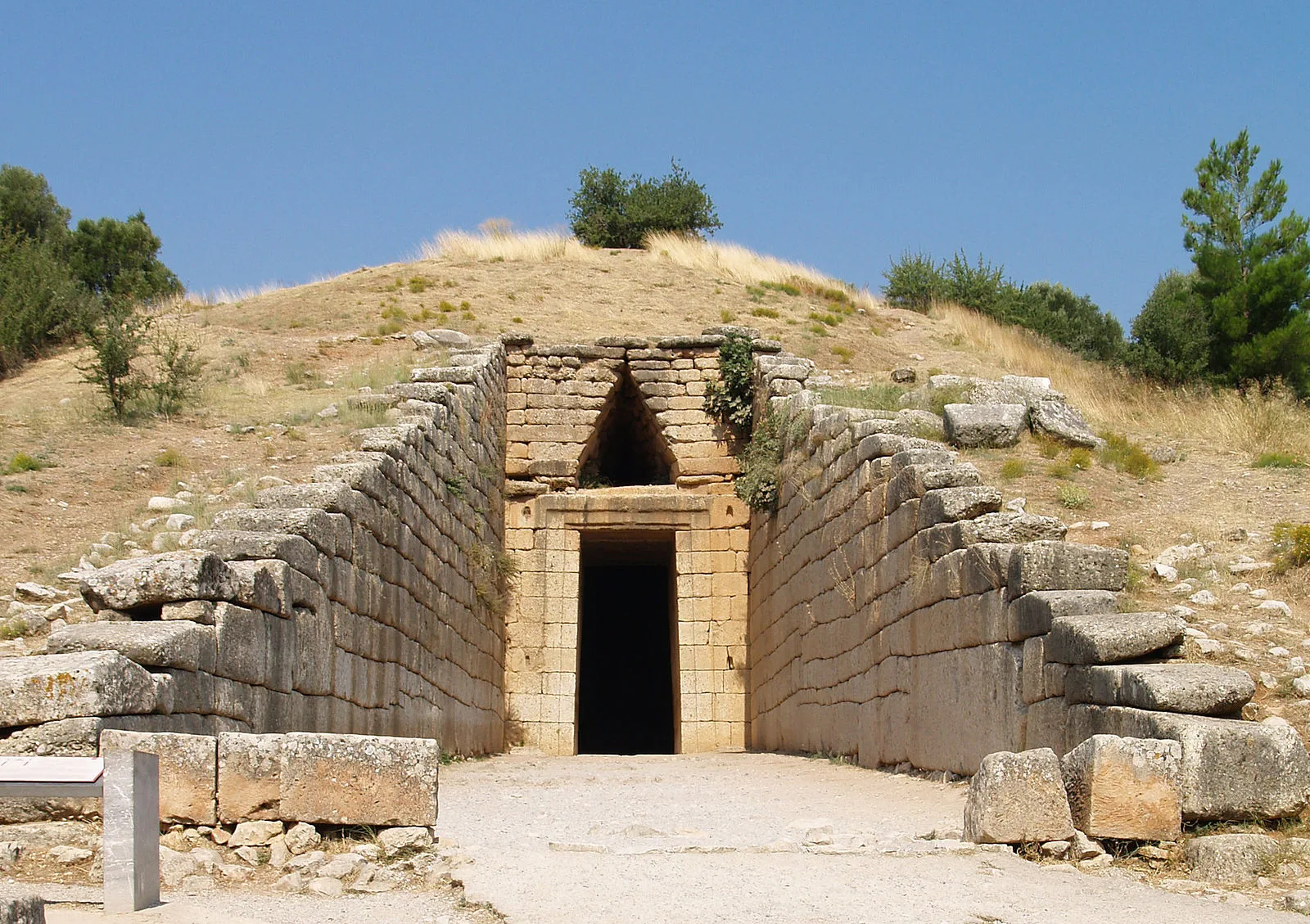
Also known as: Agamemnonova hrobka, Atrejeva riznica, Atrejeva zakladnica, Atreoren altxorra, Átreova hrobka, Atreova pokladnice, Atreuksen aarrekammio, Atreus' Skatkammer, Atreusz kincsesháza, Grobowiec Agamemnona, pokladnice krále Atrea, Schatkamer van Atreus
| Type | Necropolis/tombs complex |
|---|---|
| Period | 1500 - 500 BC |
| Country | Greece |
| Coordinates | 37.7271° N, 22.7539° E |