
 Greece
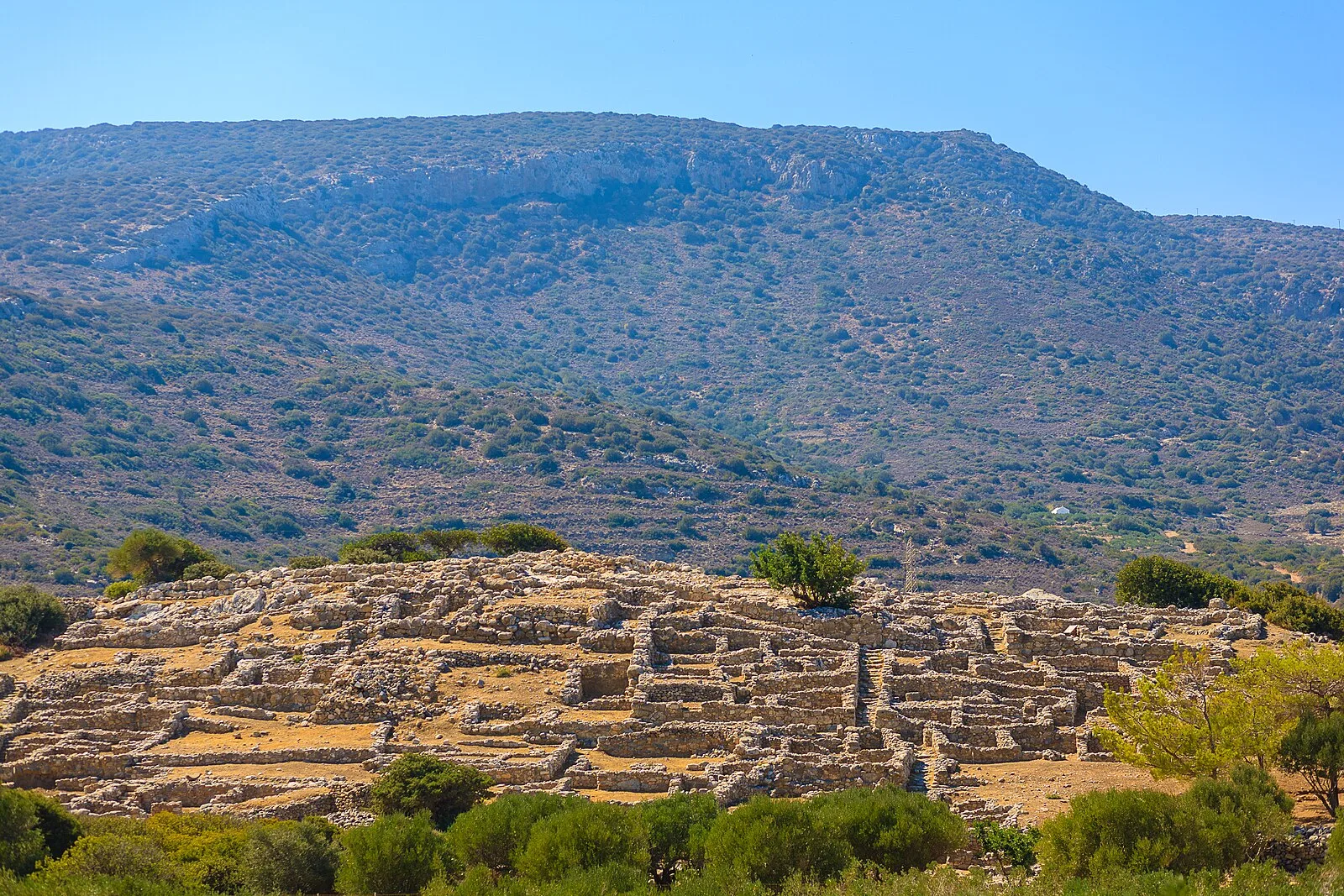
Gournia is the site of a Minoan palace complex in the Lasithi regional unit on the island of Crete, Greece [1]. Its modern name originated from the many stone troughs that are at the site and its original name for the site is unknown [1]. Harriet Boyd Hawes first excavated the Minoan village for three field seasons in 1901, 1903 and 1904 [1]. Boyd and her team were able to expose nearly the entire town, uncovering sixty houses, the cemetery, a road system connecting everything and a central building which she called "the palace" [1]. The town itself is centered around the palatial complex which is located on the central-West side of the town [1]. During the Middle Minoan IB period (1925–1875 B.C.E.) substantial construction began which was later destroyed in the Middle Minoan II period (1875–1700 B.C.E.) [1]. Rebuilding occurred in the Middle Minoan III period, which included the palace complex [1].
Text: Wikipedia – 'Gournia' (revision of 2026-07-18), CC BY-SA 4.0 · sentences selected and shortened by an AI system · source →Gournia
Also known as: Gournija, Gurnia, Gurnija, Mesto malých ľudí, Minojské Pompeje, Γουρνιά, Гурния, Ղուրնիա, גורניה, ಗೂರ್ನಿಯ, 古爾尼亞
| Type | Town |
|---|---|
| Period | 3000 - 1500 BC |
| Country | Greece |
| Coordinates | 35.1095° N, 25.7926° E |