
 Greece
Kavousi Kastro is an archaeological site in eastern Crete, Greece, about 1.4 km southeast of the modern village of Kavousi [1]. The Kastro is best known as a defensible “refuge” settlement of the “Greek Dark Ages”, inhabited from the early 12th to the mid-7th centuries BCE [1]. Most of the visible architectural remains on the site belong to the Late Geometric–Early Orientalizing phases of occupation (8th to 7th centuries BCE) [1]. Investigations by the Kavousi Project have demonstrated that a settlement on the Kastro was occupied continuously from its foundation early in the Late Minoan IIIC period (12th century BCE), through the Protogeometric (10th century BCE), Geometric (9th-8th centuries BCE) and Orientalizing (7th century BCE) periods, after which the site was abandoned [1]. The site was briefly explored in 1900 by the American archaeologist Harriet Boyd [Hawes], who discovered 13 rooms of what she thought was the house of “an early chieftain”, but now interpreted as multiple, separate house complexes spread across several terraces [1].
Text: Wikipedia – 'Kavousi Kastro' (revision of 2024-10-30), CC BY-SA 4.0 · sentences selected and shortened by an AI system · source →Kavousi Kastro
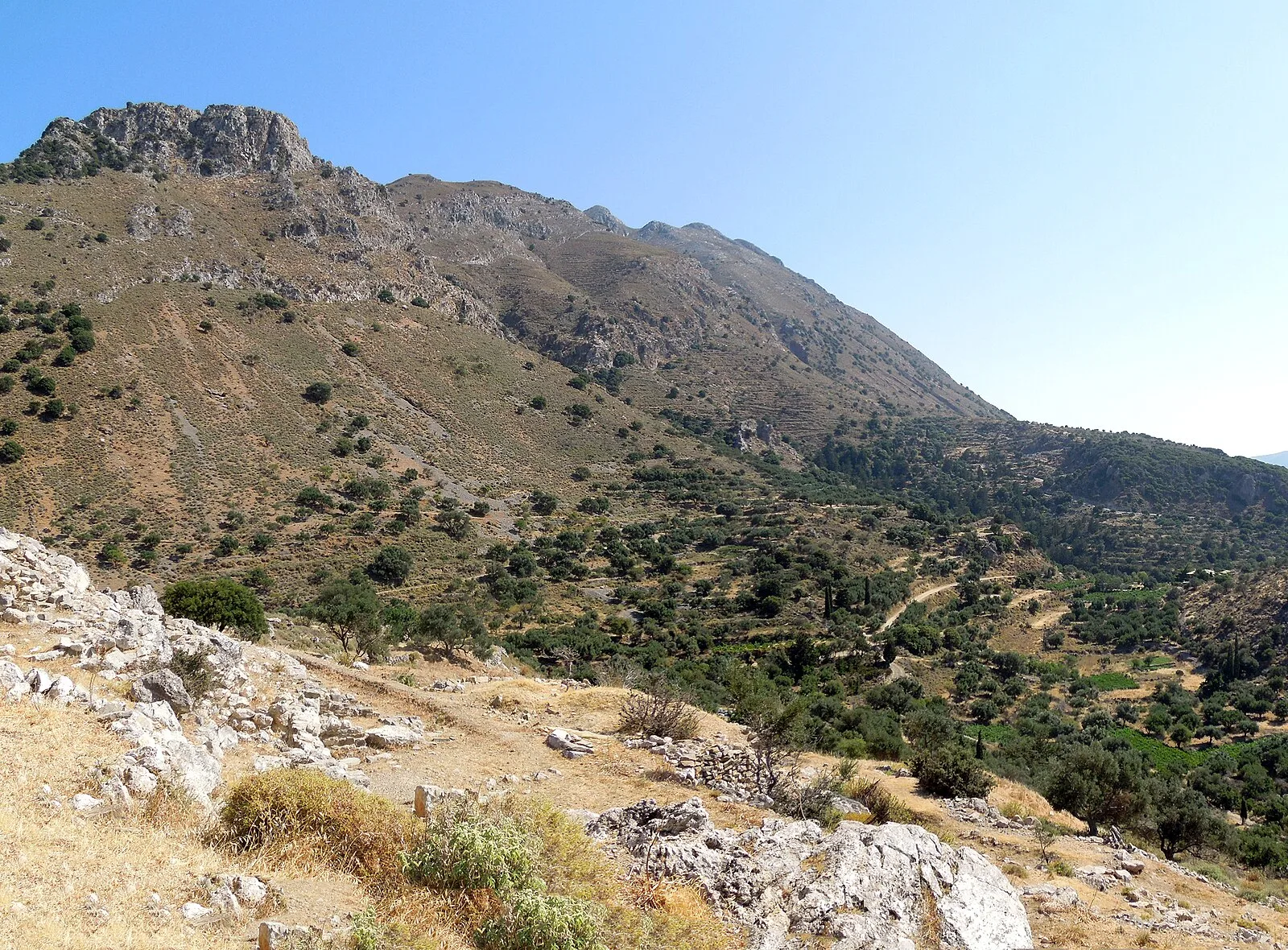
Also known as: Αρχαιολογικός Χώρος Κάστρο Βροντά, Кавуси Кастро
| Type | City/town/settlement |
|---|---|
| Period | 1500 - 500 BC |
| Country | Greece |
| Coordinates | 35.1113° N, 25.8679° E |