
 Germany
The Aula Palatina, also called Basilica of Constantine, at Trier, Germany, is a Roman palace basilica and an early Christian structure built between AD 300 and 310 during the reigns of Constantius Chlorus and Constantine the Great [1]. The basilica contains the largest extant hall from classical antiquity [1]. The hall has a length of 67 m, a width of 26.05 m and a height of 33 m [1]. The Aula Palatina generally follows the standard architectural plan of earlier basilicas, with a lack of columns in the interior and an open, box-like shape [1]. It is unique in its addition of a transverse vestibule reminiscent of a narthex [1]. The basilica was made of solid brick, with black-and-white marble floors, and was equipped with a floor and wall-heating system [1]. The basilica was originally part of a palace complex and was not a free-standing building, but had other smaller buildings (such as a forehall, a vestibule and some service buildings) attached to it [1]. The outer courtyard and railings on the first and second stories of the basilica no longer exist, but overall it is remarkably well preserved [1].
Text: Wikipedia – 'Aula Palatina' (revision of 2026-06-02), CC BY-SA 4.0 · sentences selected and shortened by an AI system · source →Basilica of Constantine
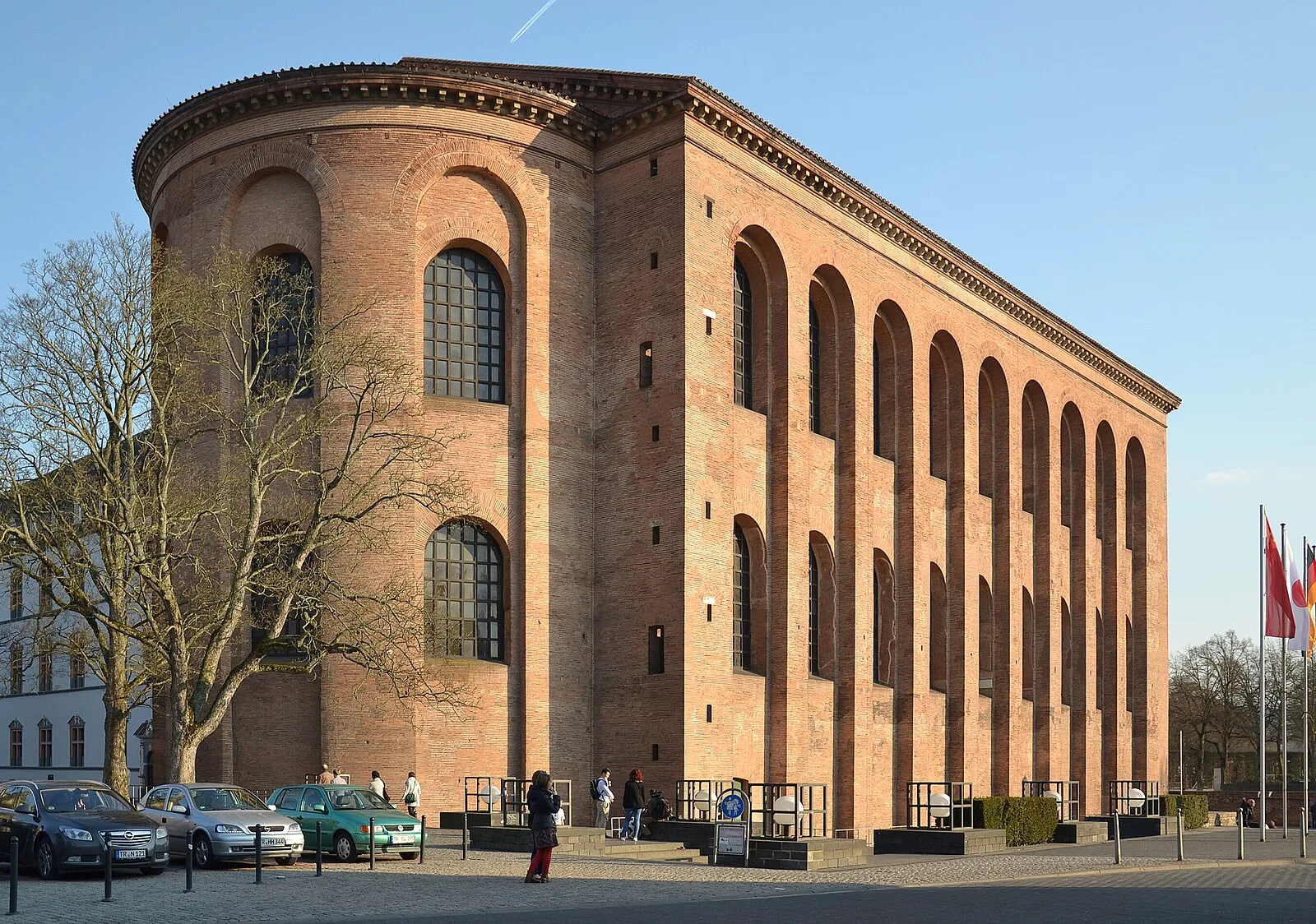
Also known as: 아울라 팔라티나, Aula Constantina, Aula Palatina, Aula Palatina (Trier), Basílica de Constantí de Trèveris, basilica de Constantino de Treveris, basilica di Costantino, basilica of Constantine (Trier), Basilica Palatina di Costantino, Basilica van Constantijn, basilique de Constantin de Trèves, Basilyk fan Konstantyn
| Type | Church/cathedral |
|---|---|
| Period | 1 - 500 AD |
| Country | Germany |
| Coordinates | 49.7533° N, 6.6433° E |