
 Australia
The Mount William stone axe quarry (traditionally known as Wil-im-ee moor-ing) is an Aboriginal Australian archaeological site in Central Victoria [1]. Known as Wil-im-ee moor-ring, meaning "axe place" in the Woiwurrung language, the greenstone quarry was an important source of raw material for the manufacture of greenstone ground-edge axes [1]. The Mount William Aboriginal stone axe quarry comprises the remains of hundreds of mining pits and the mounds of waste rock where Aboriginal people obtained greenstone, and manufactured stone blanks for axe heads [1]. The stone was quarried from the source outcrops, and roughly flaked into blanks, then taken away for finer flaking and grinding the edge [1]. There are 268 mining pits, 18 of which are several metres deep, surrounded by at least 34 discrete flaking floors, with mounds of debris up to 20 metres in diameter and some featuring a central outcropping rock used as an anvil [1]. Mount William had long been recognised as a special Aboriginal place when the first attempt was made to provide some formal protection in 1910 [1].
Text: Wikipedia – 'Mount William stone axe quarry' (revision of 2025-05-05), CC BY-SA 4.0 · sentences selected and shortened by an AI system · source →Mount William Stone Axe Quarry
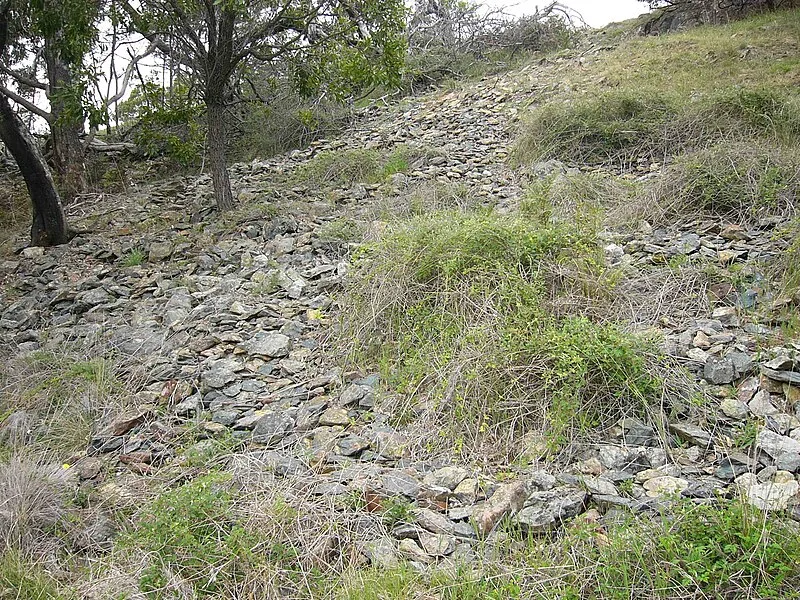
Also known as: Mount William Stone Hatchet Quarry, Wilimee Mooring
| Type | Mine/quarry |
|---|---|
| Period | Undated |
| Country | Australia |
| Coordinates | 37.2104° S, 144.8103° E |