
 Australia
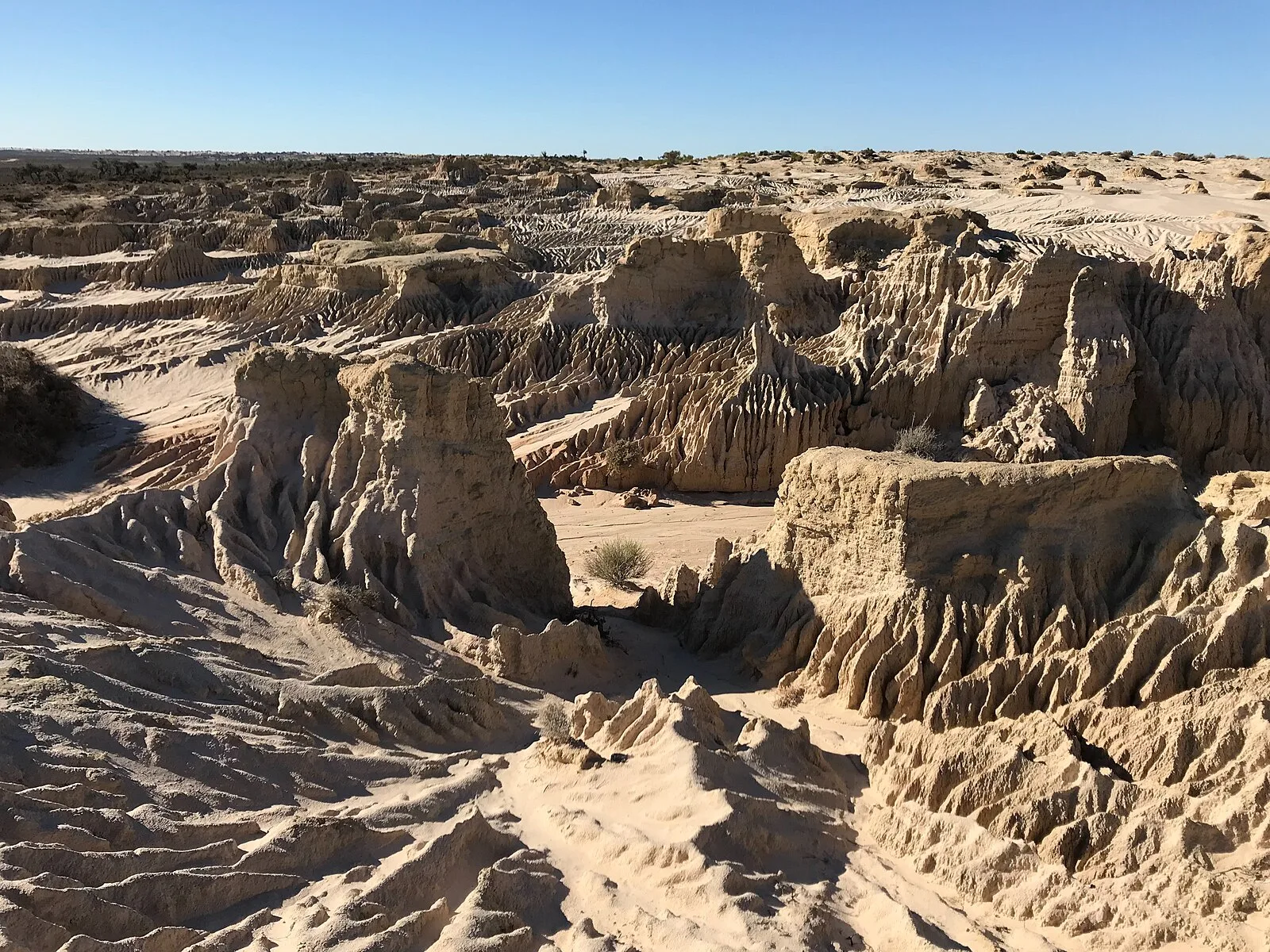
Lake Mungo is a dry lake located in New South Wales [1]. It is about 760 km due west of Sydney and 90 km north-east of Mildura [1]. Sediments at Lake Mungo have been deposited over more than 120,000 years [1]. On the eastern side of the Mungo lake bed are the "Walls of China," a series of crescent-shaped sand dunes or lunettes, up to 40 m in height, that stretch for more than 33 km, where most archaeological material has been found [1]. The most publicized findings at Lake Mungo have been Mungo Man and Mungo Woman [1]. Mungo Woman was only partially cremated before the remainder of her bones were crushed [1]. The first evidence of human occupation in Lake Mungo was revealed after an excavation of two Lake Mungo trenches contained 11 silcrete flakes [1]. Fish otoliths have been recovered from hearths in Lake Mungo [1].
Text: Wikipedia – 'Lake Mungo' (revision of 2026-07-27), CC BY-SA 4.0 · sentences selected and shortened by an AI system · source →Lake Mungo
Also known as: Danau Mungo, Jezioro Mungo, lac Mungo, Lago Mungo, llac Mungo, Llyn Mungo, Mungo, Mungo-See, Мунго, Мунго (озеро), אגם מונגו, بحيره مونجو
| Type | Geological interest |
|---|---|
| Period | 500 BC - 1 AD |
| Country | Australia |
| Coordinates | 33.7466° S, 143.0832° E |