
 Spain
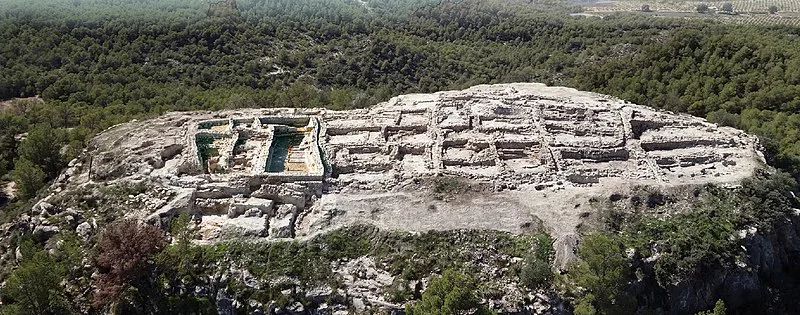
SpainLa Almoloya is an archaeological site in Murcia, the southeast corner of the Iberian Peninsula in modern-day Spain [1]. It is a principal site of study for the Bronze Age Argaric culture that flourished from about 2200 BC to 1500 BC and controlled territory in Iberia that is equivalent in size to modern Belgium [1]. The site includes the find of what is described as an "especially rich" grave 38, which was excavated beginning in 2014 [1]. It contains the skeletal remains of a woman and a man [1]. The vast majority of the grave goods are associated with the woman; it contains numerous silver grave goods, including a diadem [1]. The couple is buried beneath the floor of a large building [1]. Radiocarbon dating suggests the burial took place at approximately 1700 BC [1]. According to Lull et al., the building above the grave may be one of the earliest Bronze Age palaces identified in Western Europe [1].
Text: Wikipedia – 'La Almoloya' (revision of 2026-07-21), CC BY-SA 4.0 · sentences selected and shortened by an AI system · source →La Almoloya
Also known as: La Sociedad en Almoloya
| Type | City/town/settlement |
|---|---|
| Period | 3000 - 1500 BC |
| Country | Spain |
| Coordinates | 37.9529° N, 1.5080° W |