
 Spain
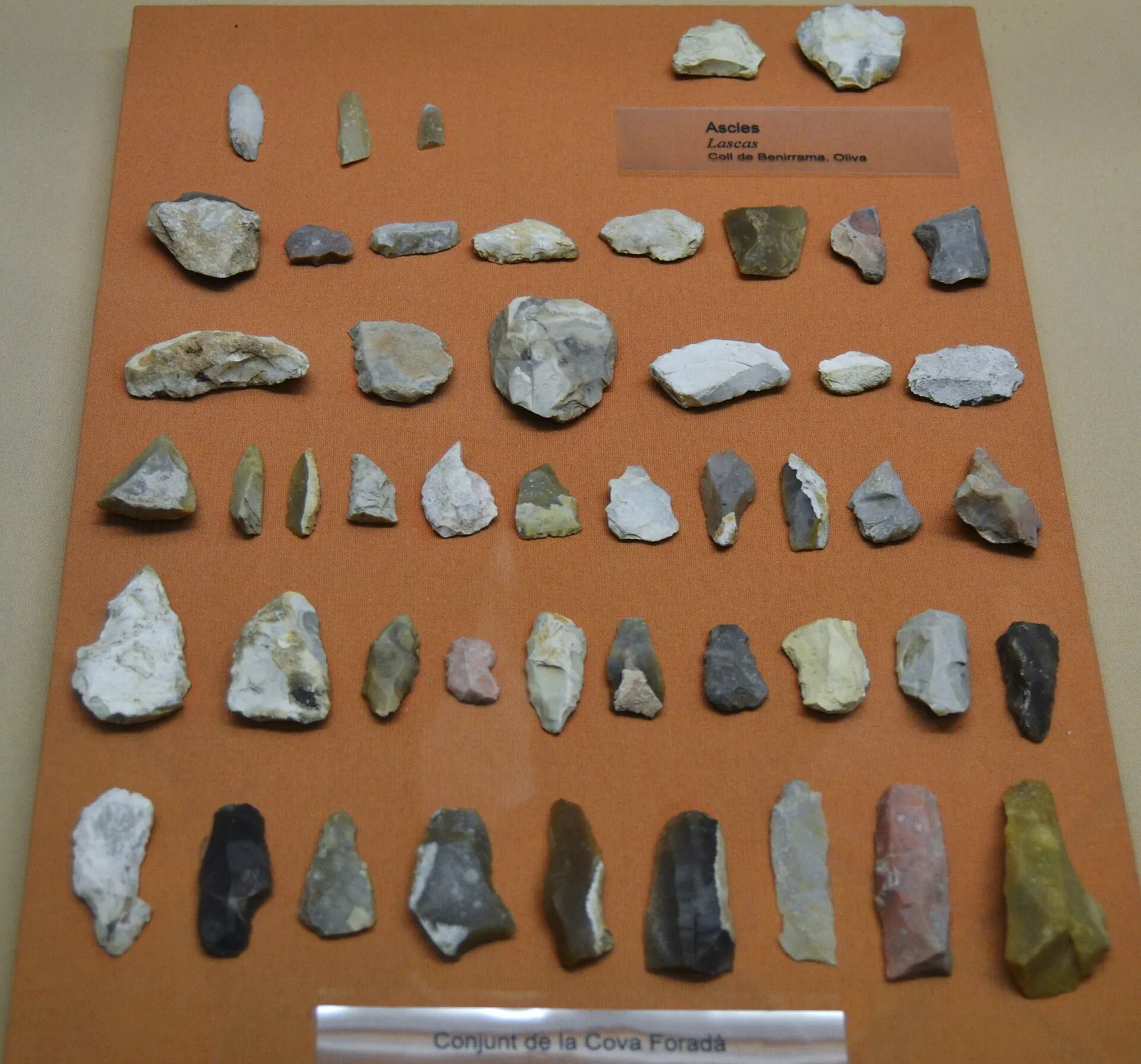
SpainCova Foradà (or Cova Foradada) is an archaeological site consisting of a cave with remains of Neanderthals near Oliva, in the Province of Valencia, Spain [1]. The most complete skeleton of a Neanderthal ever found on the Iberian peninsula was found there in 2010 [1]. The karst cave is located 5 kilometres southeast of the village of Oliva, at 3.5 kilometres from the coast of the Mediterranean, and archaeological excavations have taken place since 1977 [1]. The cave is found in a low hill, one of a group of hills called the Muntanyetes de Oliva, the last part of the Serra de Mustalla before the floodplain that ends at the coast [1]. It has been occupied since the Middle Paleolithic, including in the Mousterian and Mesolithic periods, and in the Bronze Age [1]. A maxilla (almost complete, with a number of teeth), a molar, a fibula, and four fragments of a cranium belonging to two humans were found between 2000 and 2003, in what appeared to be a layer from the Mousterian [1].
Text: Wikipedia – 'Cova Foradà' (revision of 2026-07-19), CC BY-SA 4.0 · sentences selected and shortened by an AI system · source →Cova Foradà
| Type | Cave Structures |
|---|---|
| Period | 1 - 500 AD |
| Country | Spain |
| Coordinates | 38.8833° N, 0.0907° W |