
 Spain
SpainThe Roman circus of Mérida is a Roman circus in the Roman colonia of Emerita Augusta –present-day Mérida, Spain–, capital of the Roman province of Lusitania [1]. Used for chariot racing during ancient Rome, it was modelled on the Circus Maximus in Rome and other circus buildings throughout the Empire [1]. Measuring more than 400 m in length and 30 m width, it could house up to 30,000 spectators [1]. Although currently in ruins, it is one of the best preserved examples of Roman circus [1]. After the fall of the Western Roman Empire and the rise of Christianity in Spain, the circus saw more use than the other Roman structures of Mérida, since racing was considered less sinful than spectacles performed in the Theatre and the Amphitheatre [1]. The Mérida circus however has kept numerous structures, including the Porta Pompae ("main entrance"), the Porta Triumphalis ("triumph gate"), the spina (the longitudinal wall), the tribunal iudicium ("tribune of the judges") [1].
Text: Wikipedia – 'Roman circus of Mérida' (revision of 2026-06-21), CC BY-SA 4.0 · sentences selected and shortened by an AI system · source →Roman Circus of Mérida
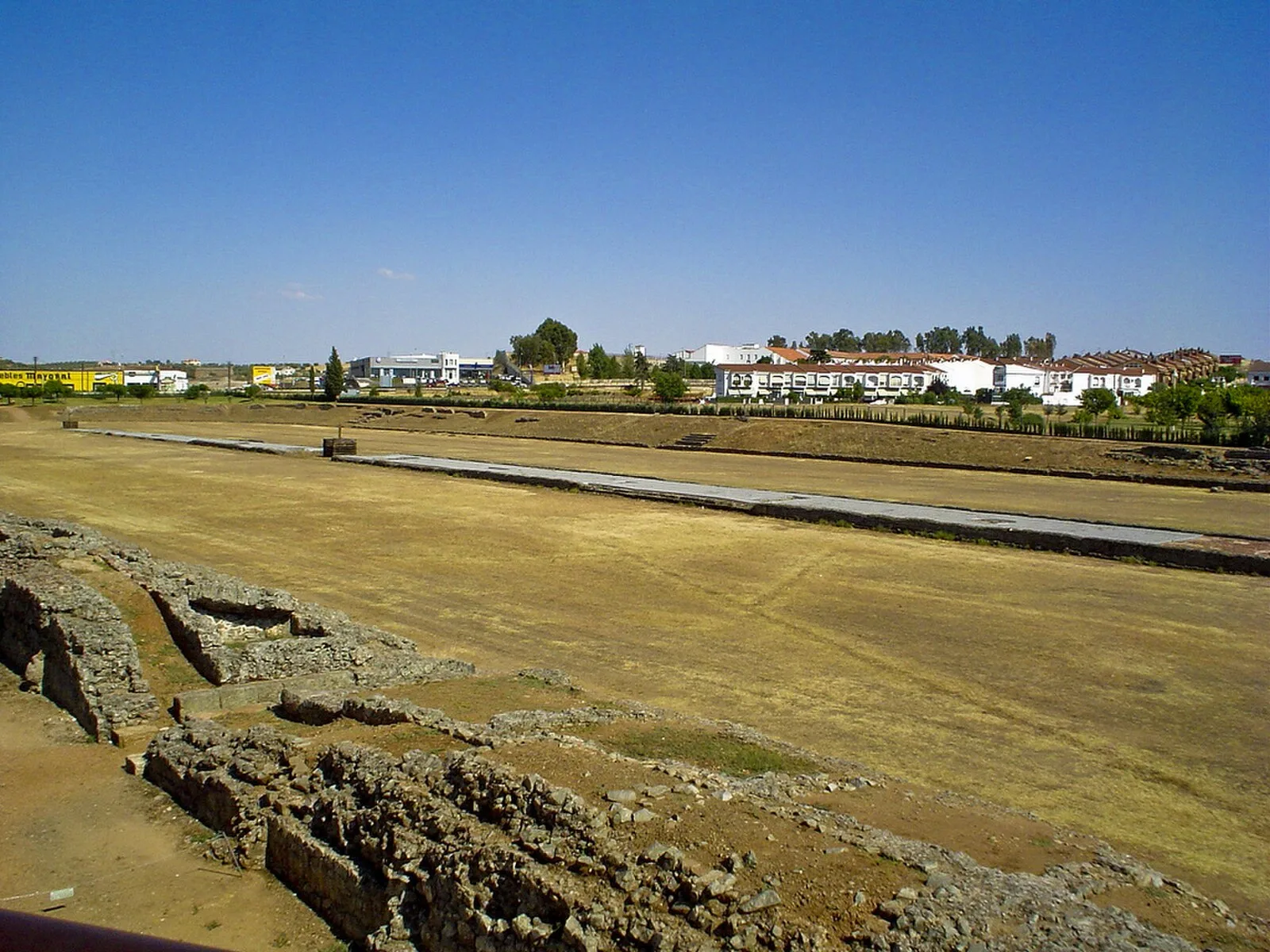
Also known as: Circo Romano, Circo romano de Emerita Augusta, Circo romano de Merida, Circo romano di Mérida, circ romà de Mèrida, Circus Maximus, Cirque romain de Mérida, Méridako erromatar zirkua, Méridako zirku erromatarra, Merida Roma Sirki, Roman Circus Maximus of Mérida, römischer Zirkus von Mérida
| Type | Stadium |
|---|---|
| Period | 500 BC - 1 AD |
| Country | Spain |
| Coordinates | 38.9163° N, 6.3378° W |