
 Malta
MaltaThe Abbatija Tad-Dejr hypogeal complex is a paleochristian burial site in Rabat, Malta [1]. The early catacombs comprised a singular shaft and chamber tombs dug from the vertical face of a quarry [1]. Baldacchino tombs are often considered to be the richest out of the array of tomb types found in Maltese catacombs; at least three such tombs in this complex are heavily decorated with reliefs [1]. In the post-Roman period, the largest catacomb was enlarged and turned into a small church [1]. The presence in the hypogeum of a stone altar and the number of crosses carved into the rock surface suggest early Christian use [1]. A fresco that, until recently, decorated the apse over the supposed location of the original altar is now housed in the National Museum of Fine Arts [1]. The catacombs underwent various other phases of use, including as cow pens and for the quarrying of stone used in the production of lime [1]. The latter has resulted in extensive damage [1].
Text: Wikipedia – 'Abbatija Tad-Dejr' (revision of 2026-07-10), CC BY-SA 4.0 · sentences selected and shortened by an AI system · source →Abbatija Tad-Dejr Hypogeal Complex
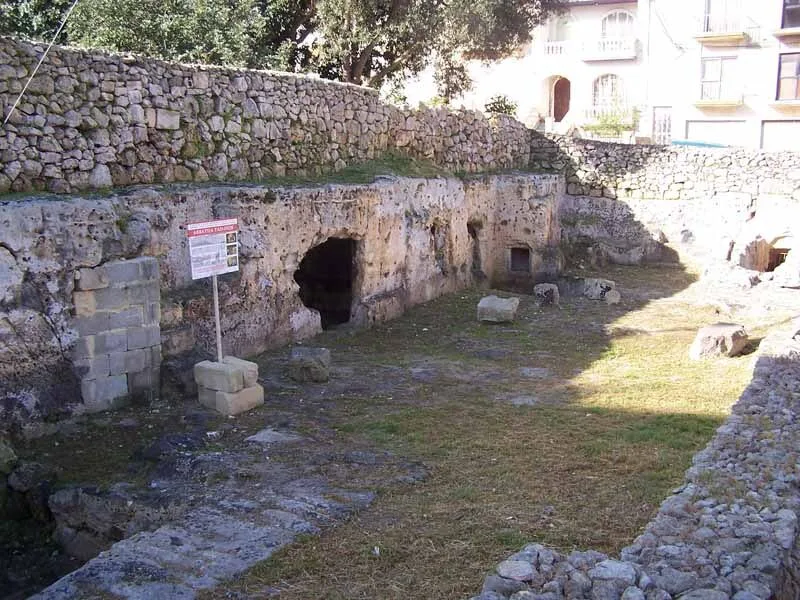
Also known as: Abbatija Tad-Dejr
| Type | Necropolis/tombs complex |
|---|---|
| Period | 1500 - 500 BC |
| Country | Malta |
| Coordinates | 35.8823° N, 14.3990° E |