
 Greece
With its secure water supply, Acrocorinth's fortress was repeatedly used as a last line of defense in southern Greece because it commanded the Isthmus of Corinth, repelling foes from entry by land into the Peloponnese peninsula [1]. The Acrocorinth was continuously occupied from archaic times to the early 19th Century [1]. Along with Demetrias and Chalcis, the Acrocorinth during the Hellenistic period formed one of the so-called “Fetters of Greece” – three fortresses garrisoned by the Macedonians to secure their control of the Greek city-states [1]. In a Corinthian myth related in the 2nd century CE to Pausanias, Briareus, one of the Hecatoncheires, was the arbitrator in a dispute between Poseidon and Helios: His verdict was that the Isthmus of Corinth belonged to Poseidon and the acropolis of Corinth (Acrocorinth) to Helios [1].
Text: Wikipedia – 'Acrocorinth' (revision of 2026-06-26), CC BY-SA 4.0 · sentences selected and shortened by an AI system · source →Acrocorinth
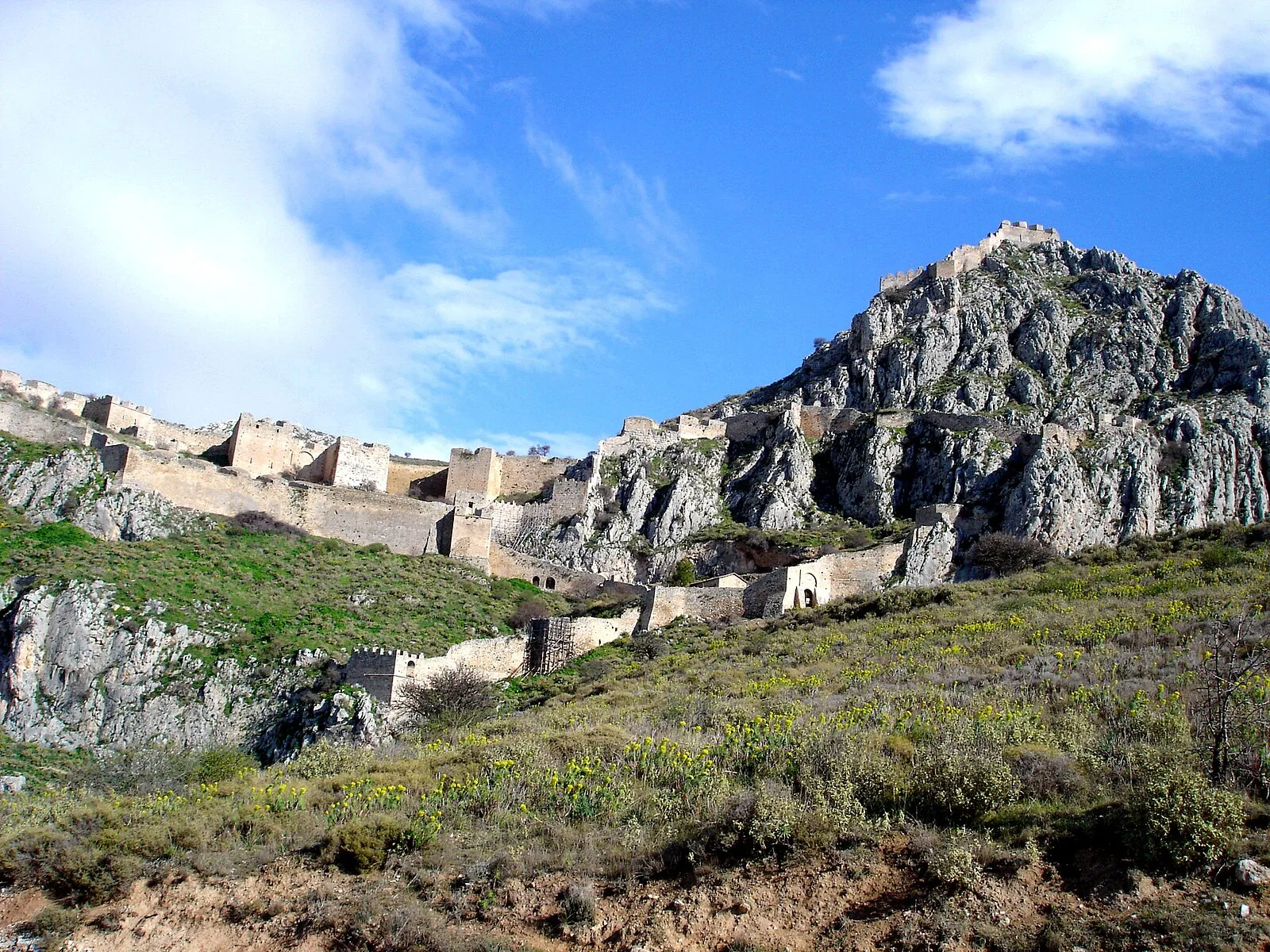
Also known as: Acrocorint, Acrocorinthe, Acrocorintho, Acrocorinthus, Acrocorinto, Akrokorinf, Akrokorint, Akrokorinta, Akrokorinth, Akrokorinthi, Akrokorinthos, Akrokorinto
| Type | Fortress/citadel |
|---|---|
| Period | 1500 - 500 BC |
| Country | Greece |
| Coordinates | 37.8894° N, 22.8697° E |