
 Türkiye
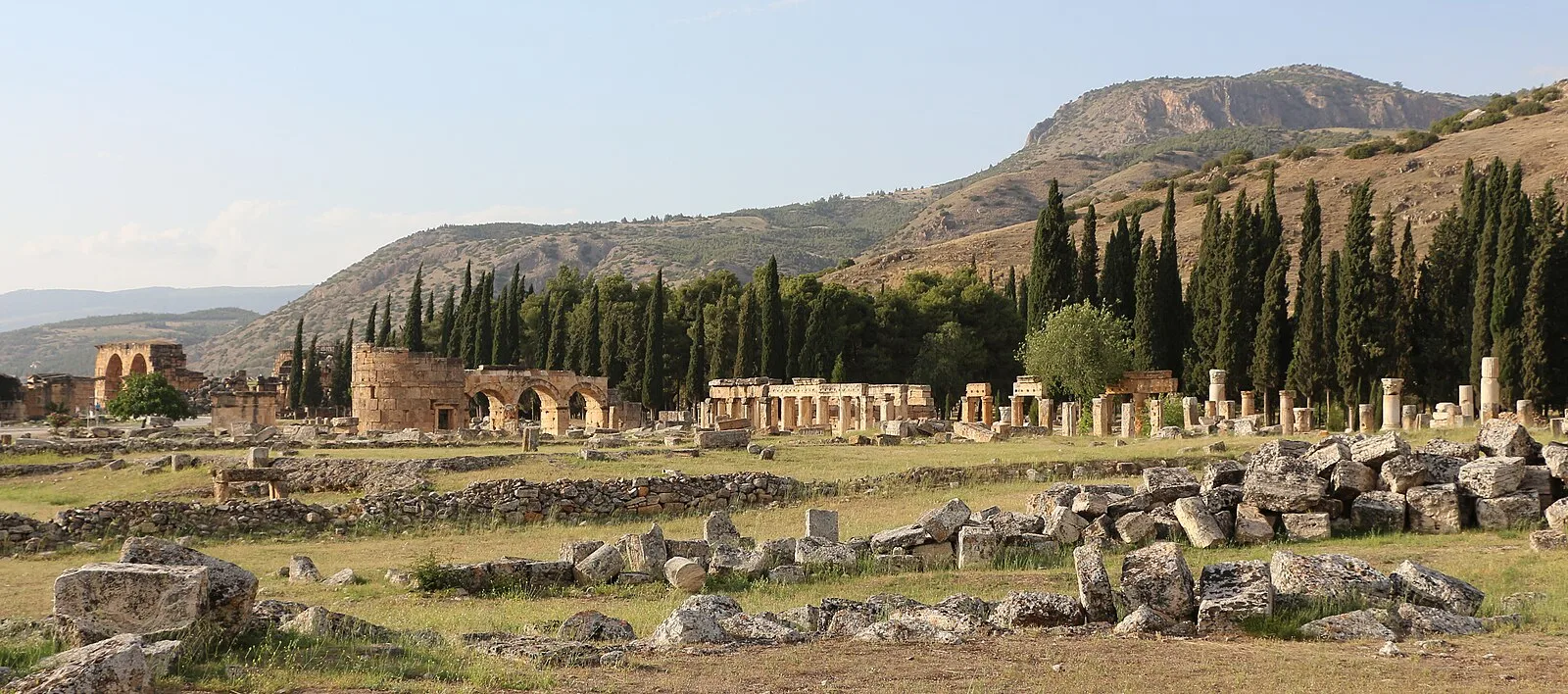
Hierapolis is located on a terrace 300 feet above the Lycus river (modern Çürüksu), a tributary of the Büyük Menderes (the classical Meander), across the valley from ancient Laodicea on the Lycus and modern Denizli [1]. The Phrygians built a temple dedicated to the mother goddess Cybele on the site probably in the first half of the 7th century BC [1]. Hierapolis was founded by the Seleucids in the time of Antiochus I (281–261 BC) and received polis status by Eumenes of Pergamon (197–160 BC) [1]. The city was famous for its high quality woollen fabrics and dye products [1]. The city was expanded with the booty from the 190 BC Battle of Magnesia where Antiochus the Great was defeated by the Roman ally Eumenes II [1]. In AD 17, during the rule of the emperor Tiberius, a major earthquake destroyed the city [1]. Hierapolis was first excavated by the German archaeologist Carl Humann during June and July 1887 [1]. The Hellenistic city was built on a grid with streets running parallel or perpendicular to the main thoroughfare [1].
Text: Wikipedia – 'Hierapolis' (revision of 2026-09-01), CC BY-SA 4.0 · sentences selected and shortened by an AI system · source →Hierapolis
Also known as: 히에라폴리스, Hierapole, Hierapoli, Hierapolis Antik Kenti, Hieràpolis de Frígia, Hierapolis (Frigia), Hierapolis (Frygie), Hierapolis (Fryygia), Hierapolisi, Hierapoliso, Hierapolis (Phrygia), Hierapôlisy
| Type | City/town/settlement |
|---|---|
| Period | 1500 - 500 BC |
| Country | Türkiye |
| Coordinates | 37.9268° N, 29.1277° E |