
 Tunisia
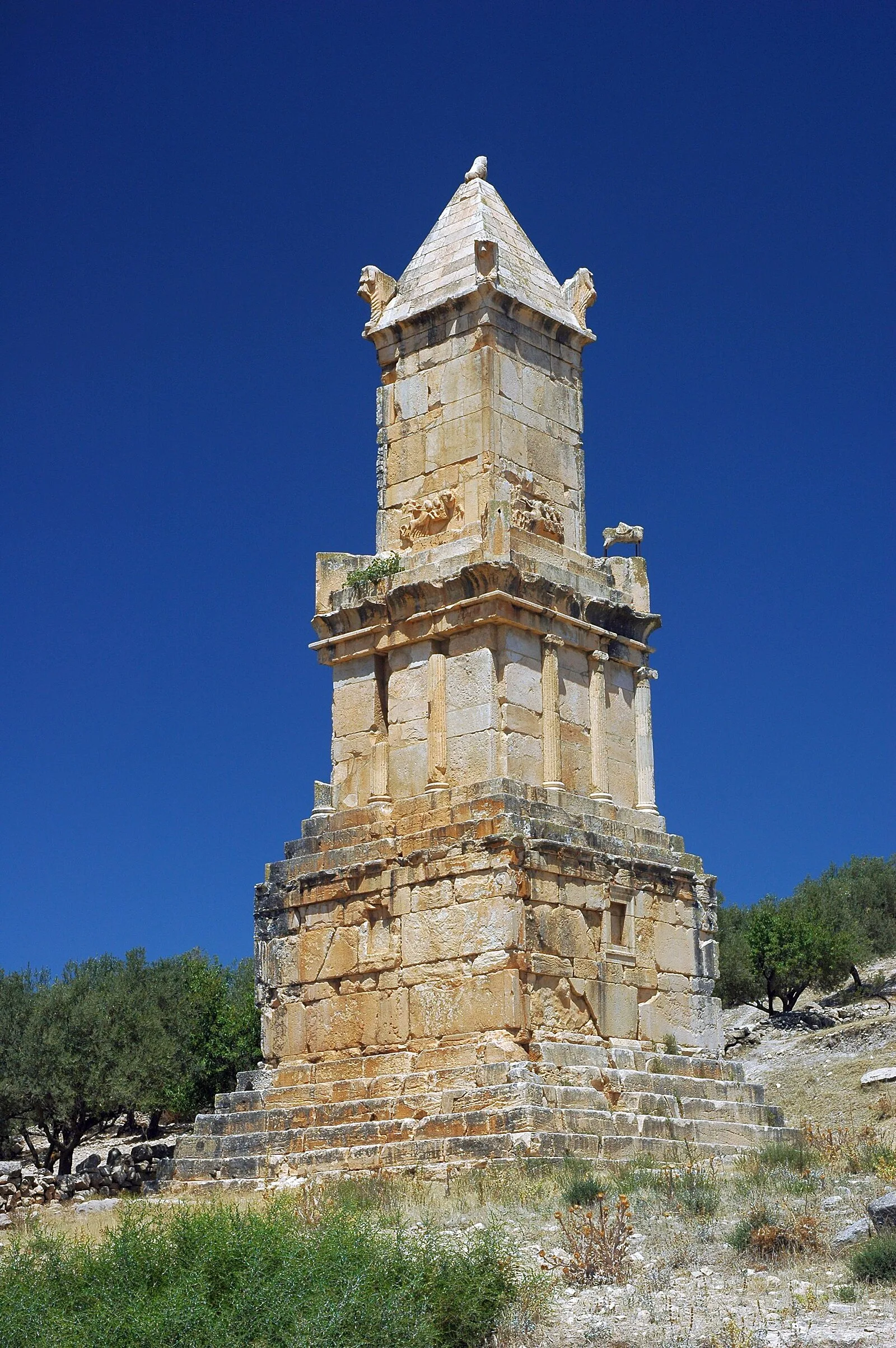
The Libyco-Punic Mausoleum of Dougga is an ancient mausoleum located in Dougga, Tunisia [1]. It is one of three examples of the royal architecture of Numidia, which is in a good state of preservation and dates to the second century BC [1]. The 21 m high mausoleum is divided into three levels, atop a five-step pedestal [1]. On the north face of the podium, the first of the three levels, an opening covered by a slab leads to the funerary chamber [1]. The mausoleum's other faces are decorated with false openings, the corners with Aeolic pilasters [1]. The sepulchre's second level consists of a colonnade in the form of a shrine (naiskos) [1]. The engaged columns on each side are of the ionic order [1]. The third and final level is the most richly decorated: in addition to pilasters on the corners similar to those on the first level, it is capped by a pyramid [1].
Text: Wikipedia – 'Libyco-Punic Mausoleum of Dougga' (revision of 2026-09-11), CC BY-SA 4.0 · sentences selected and shortened by an AI system · source →Libyco-Punic Mausoleum of Dougga
Also known as: Abarish, Duqqa məqbərəsi, Grand mausolée, Libijsko-punski mavzolej, Dougga, Libijsko-punski mavzolej, Tuga, mausolée libyco-punique de Dougga, Mausoleo líbico-púnico, mausoleo libico-punico di Dougga, mausoleo libico-punico di Thugga, Mausoleo libio-púnico de Dougga, Mausoleu libico-púnic de Dougga, Mausoleu libicopúnic de Duga
| Type | Necropolis/tombs complex |
|---|---|
| Period | 500 BC - 1 AD |
| Country | Tunisia |
| Coordinates | 36.4205° N, 9.2209° E |