
 England
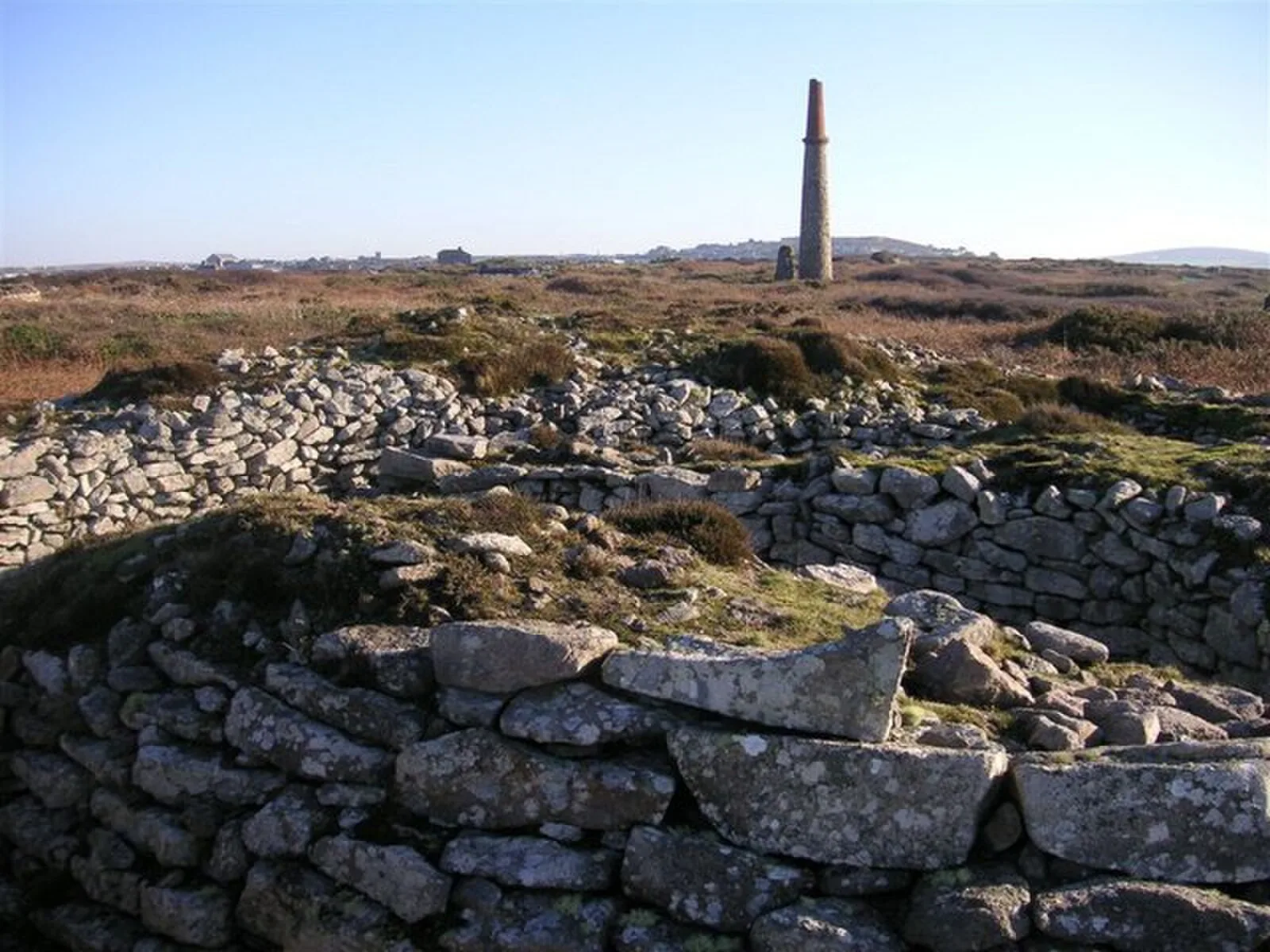
Ballowall Barrow is a prehistoric funerary cairn which Ashbee and Hencken state contains several phases of use from the Neolithic to the Bronze Age [1]. It is situated on the cliff top at Ballowall Common, near St Just in Cornwall, England [1]. It is also known as Carn Gluze Barrow [1]. It was first excavated in 1878 by William Copeland Borlase, when it was discovered under mining debris [1]. The barrow is 72 feet (22 m) in diameter [1]. The Cornwall and Scilly Historic Environment Record describes it as a central domed structure, containing cists and with a pit beneath, surrounded by an outer cairn also containing cists [1]. An entrance grave is located in the external side of the outer cairn [1].
Text: Wikipedia – 'Ballowall Barrow' (revision of 2026-07-18), CC BY-SA 4.0 · sentences selected and shortened by an AI system · source →Ballowall Barrow
Also known as: Carn Gluze, The Ballowall Barrow, The Ballowall Barrow incorporating entrance grave, cairn, ritual pits and cists 420m WSW of Bollowal Farm, 巴路禾墓
| Type | Barrow |
|---|---|
| Period | 4500 - 3000 BC |
| Country | England |
| Coordinates | 50.1225° N, 5.7014° W |